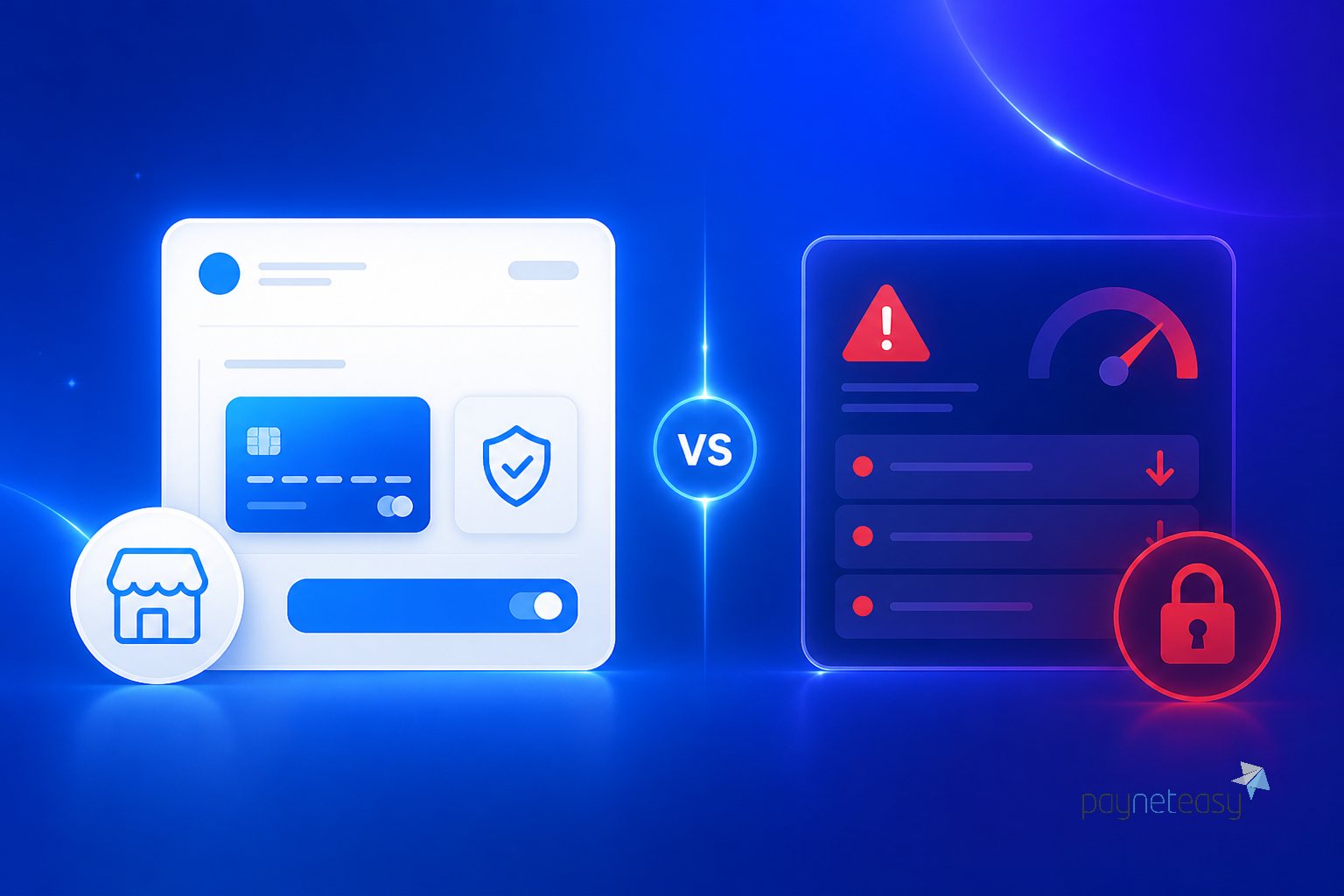
A high-risk payment gateway is the payment technology that sends transactions for authorization and routes them across acquirers and providers, with monitoring and reporting for businesses exposed to higher chargeback and fraud risk, regulatory exposure, or payment coverage risk. For a high-risk PSP, the gateway decision is practical: can the platform keep enough live acquirer and provider connections in place, with fallback routing ready when a merchant needs another payment path?
The trigger is usually operational, such as an underperforming route or a merchant that needs more payment coverage, while a backup route may need to be ready before an outage, or the team may need to understand why approval rate, settlement, or reconciliation changed. The gateway is the control layer for those decisions.
What is a high-risk payment gateway?
A high-risk payment gateway is the payment technology layer used when ordinary payment acceptance is too fragile for the business model, transaction pattern, or regulatory exposure involved. It sends card and alternative payment transactions for authorization and routes them, and it also handles the work that becomes harder under pressure: chargeback monitoring and fraud controls; acquirer and provider connections; settlement visibility and reconciliation; and routing logic across more than one path.
The word "high-risk" describes the payment exposure, not the quality of the business. A forex merchant or online casino, a gaming platform, a subscription business, a digital goods seller, or another regulated online merchant can have legitimate volume and still be treated as high-risk because its payment profile may involve refund behavior, cross-border traffic, recurring billing, regulatory review, or fraud attempts.
That is where general-purpose processing tools often become a weak fit once the business reaches meaningful scale. Large processors publish restricted-business lists and support many high-risk categories only with explicit prior approval, if at all — Stripe, for example, lists gambling among the businesses it does not support without approval. When a processor decides a risk profile no longer fits, the merchant can face reserves, withheld funds or account closure.
For a high-risk PSP, the gateway decision is more structural than a checkout choice. The gateway sits behind merchant onboarding and provider connections, as well as routing, reporting, and payment operations. If that layer has limited coverage or weak controls, the PSP has fewer options when approval rates move, chargebacks rise, or one acquirer connection becomes unavailable.
Why are some businesses classified as high-risk?
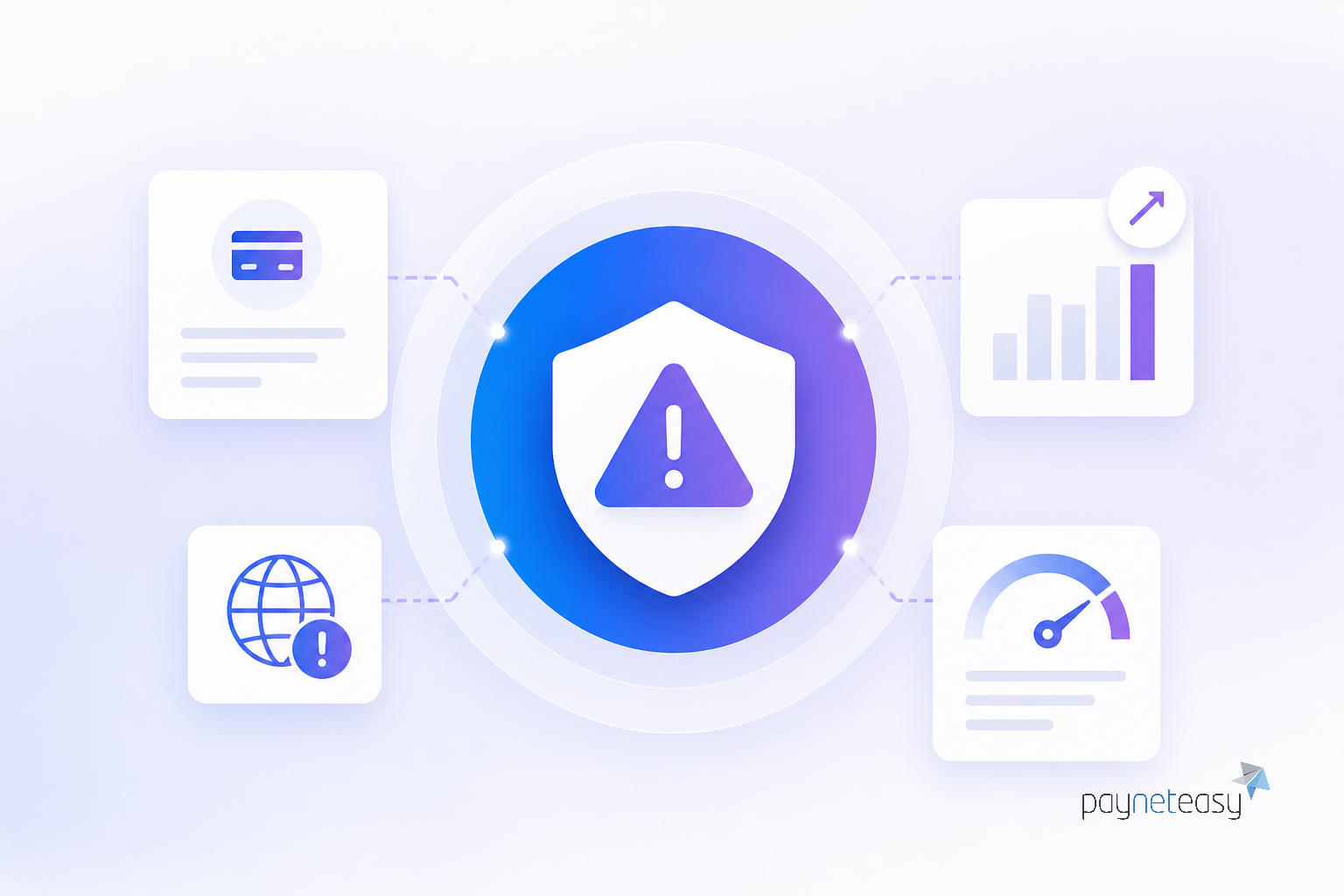
Once the gateway role is clear, the classification itself becomes easier to read. A high-risk label usually comes from a mix that includes the industry and operating model, plus transaction behavior and geography. Some factors are fixed, such as the merchant category. Others change as volume grows, new markets are added, or a payment flow starts attracting more fraud attempts.
Regulated and chargeback-sensitive verticals are the obvious examples, including forex, online casino, gaming, subscriptions, and digital goods. They may involve recurring payments and high refund sensitivity, along with cross-border customers, rapid digital delivery, bonus abuse, identity issues, or disputed authorization. None of those factors automatically makes the merchant unacceptable, but they do require stronger payment operations than a simple single-provider setup.
The wider payments market has also changed the operating baseline. EY describes payments as going through a period of radical transformation as of 2025, with new payment technologies reshaping how banks and traditional providers think about the business. For a high-risk PSP, that means more payment options to support, more provider connections to maintain, and more pressure to keep backup routes live rather than theoretical.
Cross-border payment activity adds another layer. The IMF has warned that digitalization in ASEAN has introduced significant financial crime and money laundering risks, especially in cross-border transactions, where criminals can exploit regulatory inconsistencies and payment speed. That point matters outside ASEAN as well because the operating pattern is familiar: fast payments across multiple jurisdictions, with identity risk and fragmented rules adding more review work for providers.
Post-authorization activity also shapes the risk view, including chargebacks and refunds, settlement delays, decline-code patterns, and reconciliation gaps. A high-risk merchant with clean reporting and controlled chargebacks is different from one that cannot explain why approvals dropped in one country or why a specific BIN range started failing. For the PSP, the practical question is whether the gateway can show those patterns early enough to protect the payment flow.
Key terms for high-risk payment processing
With the classification understood, the vocabulary becomes more useful. Payment teams use these terms because each one maps to a specific operating decision.
Chargeback
A chargeback is a transaction reversal initiated through the cardholder's issuing bank. In high-risk payment operations, chargebacks affect acquirer appetite and merchant monitoring, as well as reserve discussions and routing decisions. A gateway should make chargeback patterns visible by merchant and provider, by country and card BIN, and by reason code so the team can separate fraud from customer-service issues and technical failures.
Fraud controls
Fraud controls are the rules and checks, along with monitoring workflows, used to identify suspicious transactions before or after authorization. In high-risk payments, the goal is controlled exposure. A strong setup lets the PSP adjust filters and authentication, plus velocity checks and review rules, without blocking good traffic by default.
Acquirer connection and provider connection
An acquirer connection links the payment flow to an acquiring bank or acquiring service. A provider connection can include PSPs and acquirers, alternative payment methods, fraud tools, and related services. The important point is operational coverage. A connection that exists in a contract but is not technically live cannot protect a payment flow during a payment issue.
Routing with fallback routing and cascading
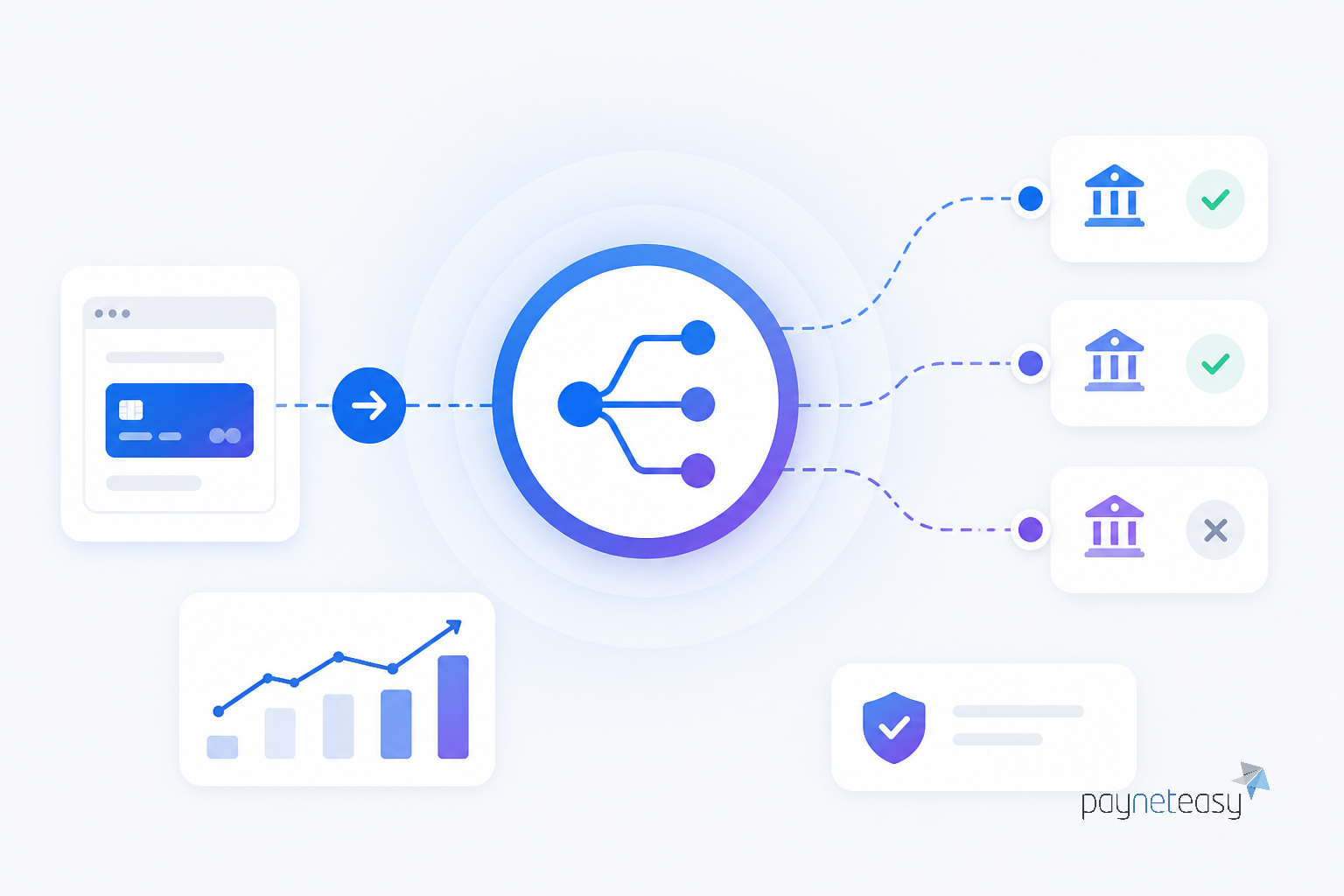
Routing decides where a transaction is sent. Fallback routing sends a transaction to another available path when the first path is unavailable or unsuitable. Cascading is a related pattern where a declined or failed transaction can be retried through another route under defined rules. These controls matter because high-risk PSPs and merchants often need more than one live path for the same payment method and market, or the same risk segment.
Settlement with reconciliation and reporting
Settlement is the movement of funds after transactions are processed. Reconciliation checks gateway records against provider and financial records. Reporting gives the operational view needed to diagnose changes in approval rate, declines, chargebacks, and settlement status. Weak reporting turns payment operations into guesswork.
Payment orchestration
Payment orchestration is the technology layer that coordinates multiple payment providers and payment methods, with routing rules, authentication flows, and reporting from one operating point. For a high-risk PSP, orchestration is useful when it reduces engineering time while keeping provider coverage, routing, and operational visibility under control.
Essential requirements of a high-risk payment gateway
The requirements follow from the operating problem. A high-risk gateway has to do more than pass transaction messages between a checkout and a processor. It has to keep payment coverage usable while risk and compliance pressure, provider performance, and technical acceptance move at the same time.
The first requirement is multi-connection coverage. A high-risk PSP should be able to operate across several acquirer connections and provider connections, with each route configured and tested, then available for production traffic. Backup capacity only matters if it is live and connected, with controls in place before a payment issue. A backup route that still needs engineering work during an incident remains a plan rather than payment coverage.
Routing is the second requirement. The gateway should support rules based on provider and country; currency and card type; BIN and payment method; decline code; risk signal; and operational limits. For a deeper breakdown of how this works, the guide to intelligent payment routing capabilities explains the logic behind smarter route selection. In high-risk operations, routing preserves a working payment flow while the team diagnoses the issue, with elegance a secondary concern.
Fraud and chargeback controls sit close to routing because risk and acceptance cannot be managed in isolation. If fraud filters are too loose, the PSP carries downstream exposure. If they are too strict, approval rate can fall for good customers. The gateway should allow controlled rules and clear event logs, with reporting that lets payment operations see whether a decline pattern is technical or risk-based, driven by an issuer, or specific to a route.
Authentication also matters. 3-D Secure and regulation-aligned authentication can support approval rates when configured correctly, but the setup must fit the transaction mix. A blanket approach may add friction in the wrong places. A weak approach may push too much risk downstream. The gateway needs enough control to apply authentication based on payment flow and geography, as well as provider requirements and merchant profile.
Operational reporting is the requirement that separates a usable high-risk payment gateway from a black box. Payment teams need to break performance down by provider and route, country and card BIN, decline code, merchant, and time period. Without that view, teams may move traffic before they know whether the issue is a provider outage or card range problem, a rule conflict or issuer behavior, or merchant-specific risk.
This is also where the technology provider's operating proof matters. Payneteasy provides a payment orchestration platform for managing providers and payment flows, plus acceptance and cost across an active setup. The platform is PCI DSS Level 1 compliant; includes more than 1,000 integrations; supports Payment Channels for a new PSP connection within 1 to 2 weeks; has capacity for up to 10 million transactions per day; and 99.95% verified uptime. Those figures do not remove the need for risk management, but they show the kind of payment infrastructure scale high-risk payment operations often require.
How to choose the right high-risk payment gateway
The selection process should start with payment coverage rather than a generic provider shortlist. The practical question is simple: can the gateway support the acquirer and PSP connections, payment methods, and backup routes your business needs to keep live? If the answer depends on future development work, the risk remains with your team until that work is complete.
Start with your real payment flows. List the countries and currencies, card types and payment methods, merchants, recurring models, and high-volume segments that matter. Then map where each flow goes today, what fallback route exists, and how quickly operations can change routing when approvals drop. This exposes the difference between contractual coverage and working coverage. A signed relationship with a provider is useful, but only a tested connection can carry traffic during a payment issue.
Treat security and compliance as operating requirements instead of procurement checkboxes. Ask about PCI DSS scope and data handling, authentication support and fraud controls, access rights, audit trails, and how operational data is protected. This does not replace legal or compliance advice for a specific jurisdiction, and it should not be treated as that. It is a technology assessment: can the gateway support the controls your risk and compliance teams expect to operate?
Risk governance also deserves a practical review. Accenture's Risk Study is based on a survey of more than 700 risk professionals conducted between April and June 2023, which is a useful reminder that payment risk belongs to a broader operating discipline rather than a narrow gateway setting. For a PSP, that means the gateway has to give risk and finance teams plus payment operations the same usable view of what happened: approvals and declines, chargebacks, settlement, reconciliation, and routing decisions.
The next filter is engineering workload. Direct integration often looks manageable at the first provider connection. It becomes a permanent workload as APIs change and new providers are added, while authentication requirements shift and reporting gaps appear. A high-risk merchant may tolerate that burden for a while, but a high-risk PSP usually needs a technology layer that turns connection work into an operating capability rather than a series of one-off projects.
Support should be assessed in the same concrete way. Ask what happens when a route fails, when settlement reporting does not match, when approval rate drops in one country, or when a new acquirer connection must be tested under time pressure. The right gateway team should be able to speak in payment operations terms: route and provider; MID and country; BIN and decline code; chargeback, settlement, and reconciliation.
Pricing matters, but it should be read alongside resilience and workload. A low visible gateway cost can become expensive because the PSP carries the engineering burden or lacks backup capacity, especially if it cannot diagnose acceptance drops fast enough. Use questions to ask providers that force operational answers, not vague assurances. The strongest evaluation is usually a payment-flow review: show the provider your real routing needs and ask how each path would be connected and monitored, then changed.
Next steps: implementing your payment strategy
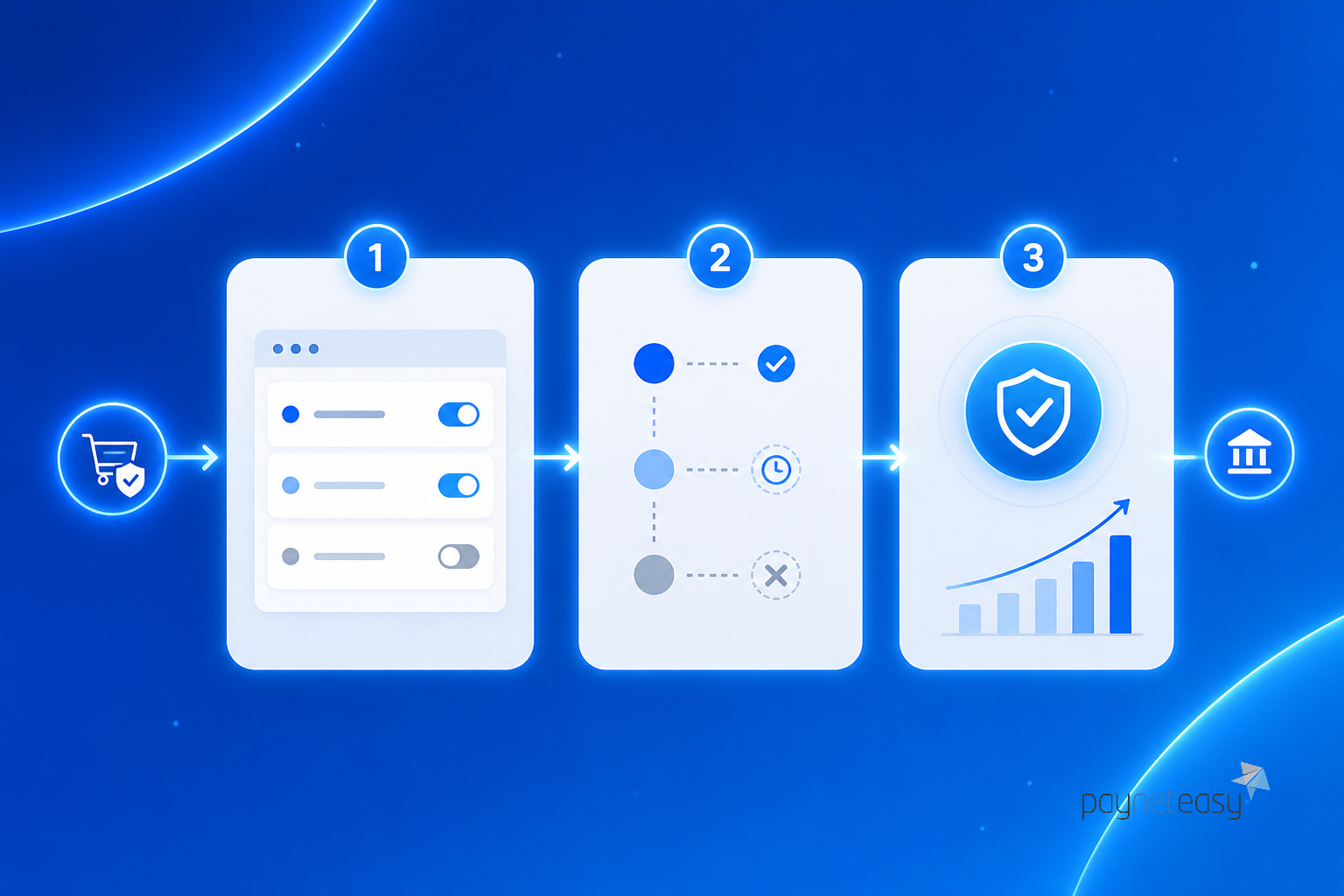
After gateway selection, the work shifts from evaluation to operating discipline. The goal is to build payment coverage that is live before it is needed. That means documenting current routes and confirming which provider connections are production-ready; testing fallback routing; and making sure reporting can explain approval rate changes without manual reconstruction across separate systems.
A sensible rollout starts with the highest-risk payment flows first: markets with fragile approval rates; merchants with the highest chargeback exposure; routes that lack backup capacity; and payment methods that carry the most revenue. From there, the team can decide which connections need to be added, which routing rules need tighter control, and which reporting views must be available to operations, finance, and risk.
Use a payment provider readiness checklist before treating any route as a real backup. Confirm credentials and test transactions, decline handling and settlement files, reconciliation fields and reporting access, operational contacts, and routing rules. High-risk payment infrastructure takes more upfront control than a single-provider setup. The practical value appears when a payment issue hits: the PSP has a live payment path and data to diagnose the pattern, with fewer decisions made under pressure.