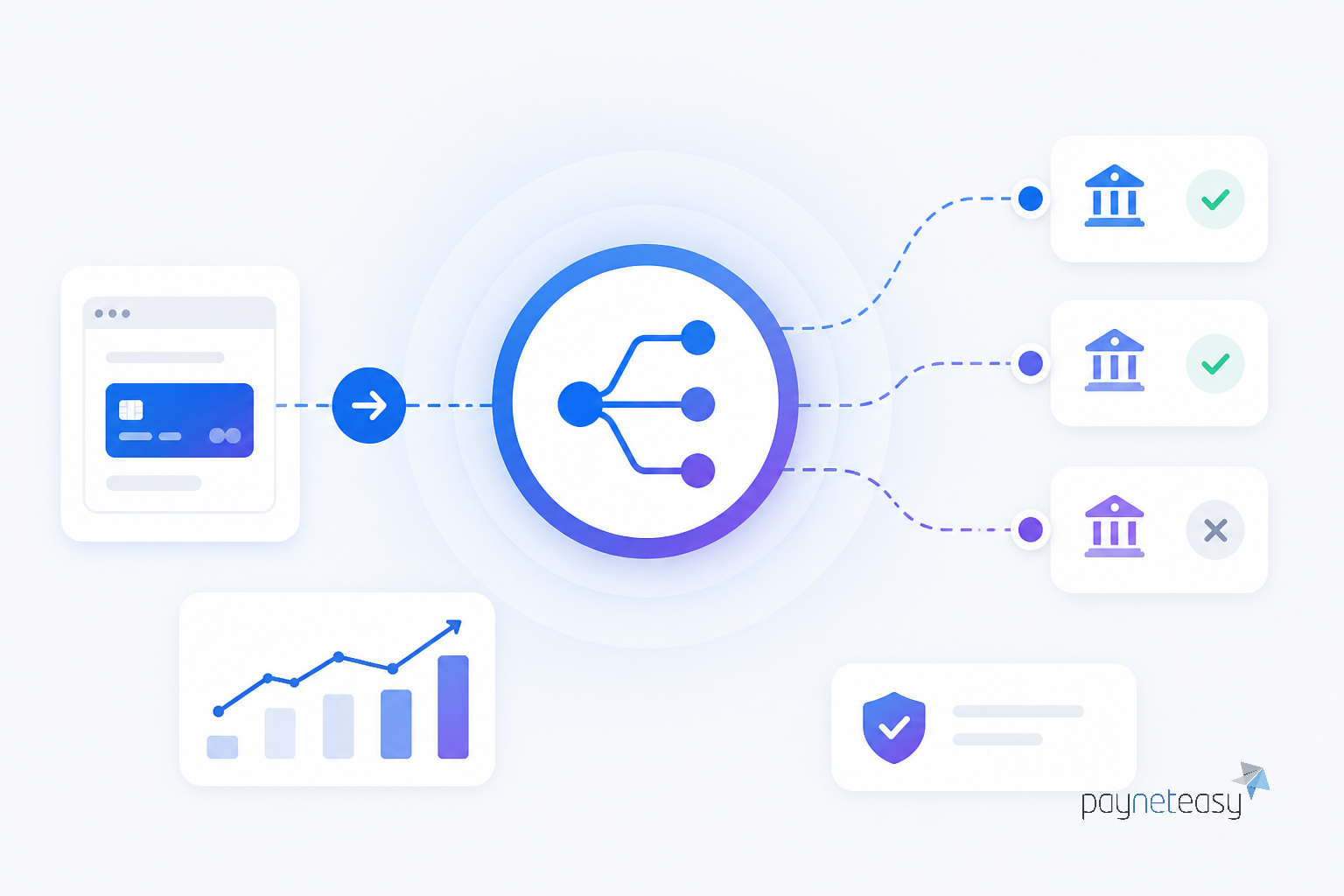
What is payment routing?
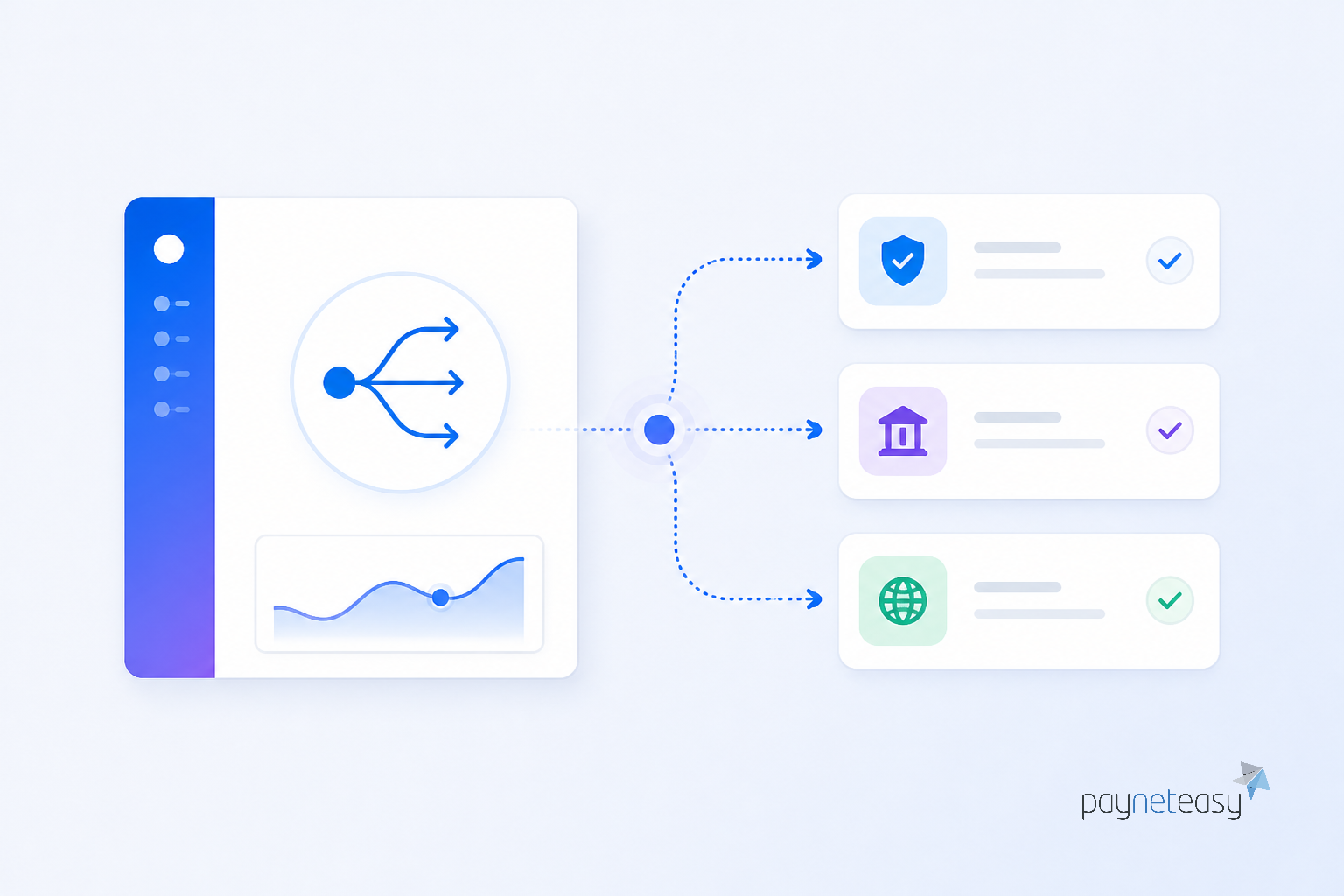
Payment routing is the way an online payment is sent to the most suitable PSP or acquirer connection instead of being pushed through one fixed path. It directs transactions across different PSPs and acquirers based on predefined rules, so the team can manage approval rates and costs while keeping payment flows running when one route has a payment issue.
For a high-risk PSP, that definition is operational. A merchant needs more payment coverage. An acquirer connection starts declining a specific transaction pattern. Operations needs a backup route ready before the problem reaches live volume. Routing is the payment technology layer that decides where each transaction should go, using the rules and provider connections already available.
A useful payment routing definition has three parts. First, there must be more than one available route. That can mean multiple PSP connections, multiple acquirer connections, or a mix of provider connections behind the same checkout. Second, the routing logic must make a decision before the transaction is submitted. That logic can be simple, based on country, currency, payment method, amount, or merchant account. It can also be more detailed, using card BIN, decline pattern, technical error rate, risk flag, or capacity threshold. Third, routing should create an operational result. Examples include approval rate management, cost control, backup capacity, cleaner reporting, or faster diagnosis when payment performance changes.
The broader payments market has moved toward this kind of control layer. McKinsey describes payments value as shifting toward the control layer of trust, dynamic routing, and agentic rails as checkouts become part of software flows. That matters because routing is no longer a back-office setting inside one provider account. It is part of how a PSP or merchant controls acceptance and resilience while managing the cost of moving money.
Payment routing also sits close to payment orchestration, but the two terms are different. Routing is the decision about where a transaction goes. Orchestration is the broader layer that manages provider connections, routing rules, payment flows, reconciliation, reporting, and operational control. If you need that distinction before going deeper, this guide on payment orchestration vs. payment gateway gives the wider architecture view.
Key terms in payment routing
With the definition in place, the main terms are straightforward.
A PSP, or payment service provider, is the provider connection that helps a merchant accept online payments. In a high-risk PSP setup, the PSP may manage many merchant payment flows and needs enough coverage to avoid depending on one path.
An acquirer connection is the connection to an acquiring bank or acquiring-side provider that receives authorization requests and supports settlement. In routing discussions, acquirer coverage matters because different acquirer connections may perform differently by country, card type, currency, merchant category, or risk profile.
A route is the path a transaction takes from checkout through the payment gateway or orchestration platform to a provider or acquirer connection. A route is live only if it is connected and tested, with payment operations able to manage it.
Routing rules are the conditions that decide which route receives a transaction. Rules may use transaction attributes, merchant settings, country, currency, card BIN, payment method, risk score, decline code, provider availability, or cost logic.
Fallback routing uses an alternative eligible route when the primary route is unavailable. Cascading allows another payment attempt through a configured connection after an eligible decline, subject to the chain’s continuation and stop conditions. A timeout alone does not confirm that the original attempt failed.
Load balancing spreads traffic across available routes according to business or technical settings. For a high-risk PSP, this may support backup capacity, provider limits, uptime planning, and operational resilience.
Approval rate is the share of attempted transactions that are authorized. It is affected by risk controls, issuer behavior, acquirer performance, transaction data quality, authentication, and routing.
Reconciliation is the process of matching transaction records with provider reports, settlement files, fees, chargebacks, and payouts. Routing makes reconciliation more important because the same merchant may have volume moving through several active paths.
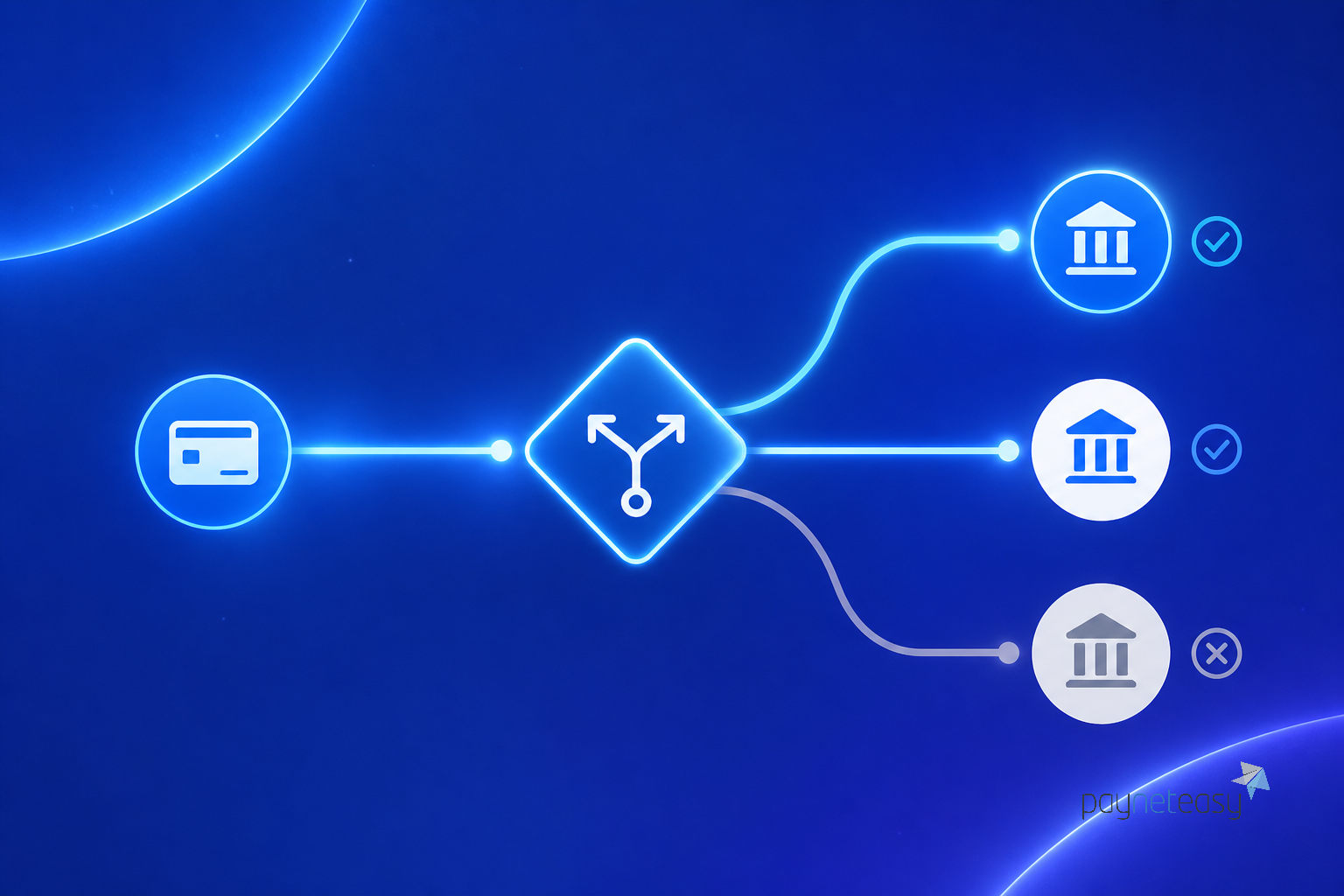
Why payment routing is critical for high-risk merchants
The terminology matters because high-risk payment operations cannot treat provider coverage as a static setup. A high-risk PSP needs more live acquirer and PSP connections, plus more payment options for its merchant base. It also needs backup routes that are ready before a payment issue appears in production.
Cost pressure is one driver. In BCG's survey of nearly 500 large merchants, rising payment costs were the norm: 79% said payments costs had gone up over the previous five years, while fewer than one in ten had reduced them. Routing does not make cost disappear, and no serious payment leader should expect it to. What it does is give operations a way to choose between eligible paths instead of sending all volume through a fixed connection, then discovering later that the setup has become expensive or weak for a specific segment.
The second driver is performance discipline. BCG found that, in 2026, 28% of large merchants manage payments as a profit center, taking a broader view than just reducing complexity and controlling costs. Those merchants are more likely to track authorization rates and false-positive fraud rates, along with conversion and acquirer review cycles. That is the operating mindset routing requires. If a PSP cannot see approval rate by provider, route, country, card BIN, and decline code, it cannot make routing decisions with confidence. It can only move traffic and wait.
The third driver is the high-risk environment itself. High-risk merchants often operate in regulated, chargeback-sensitive, or acceptance-sensitive categories. Treasury's 2026 National Money Laundering Risk Assessment states that payment processors outside the scope of the BSA have no legal obligation to conduct customer due diligence or file SARs, which can make them an attractive avenue for illicit finance. That is not a routing rule by itself, and it is not legal advice. It is a reminder that high-risk payment coverage must be managed with controls and visibility, plus careful provider selection.
The evidence also points to a practical result when orchestration is handled well. BCG reported that the 12% of large merchants combining a profit center mandate and a dedicated payments team with dynamic orchestration outperformed the survey average in 2026. Their conversion and authorization success rates were 2 percentage points higher, their fraud rates were 0.5 percentage point lower, and their share of transactions stopped by fraud controls was 1 percentage point lower. Those are survey findings, not a promise for any single PSP or merchant. Still, they show why payment routing belongs in the operating model rather than in an emergency playbook.
For a deeper view of the merchant-side constraints behind this, the guide to high-risk merchant payment processing covers acceptance and risk as well as provider coverage in more detail.
How payment routing works: common strategies and rules
Once the reason for routing is clear, the operating work becomes more concrete. Payment routing works by applying decision logic before a payment request is sent, after a response comes back, or both. The rules can be static or dynamic, and more advanced models may support them. The operating question stays the same: given the transaction, the merchant, the risk signal, and the available connections, which route should handle this payment?
Rule-based routing logic
Rule-based routing is the most familiar starting point. A high-risk PSP defines conditions, then maps those conditions to a payment flow. A simple version may send one country to one acquirer connection and another currency to another PSP connection. It may also map a specific merchant category to a provider that supports that category. A more detailed version can include card BIN, amount bands, payment method, merchant ID, decline codes, issuer country, authentication result, or provider capacity.
The advantage is control. Payment operations knows why a transaction went to a given route because the rule is explicit. That matters in high-risk portfolios, where merchant onboarding and chargeback exposure have to stay aligned with provider requirements and settlement expectations. If a route starts returning technical errors, the team can isolate the affected traffic and change a narrow rule instead of moving all volume.
The trade-off is maintenance. Rules age, provider behavior changes, and merchant traffic shifts. A rule that worked for one segment can become too broad or too expensive, or it may weaken approval rate. That is why reporting matters as much as the initial routing setup. Without reporting by provider, route, country, card BIN, and decline code, the PSP cannot tell whether a routing change solved the payment issue or simply moved it somewhere else.
Academic work on multibank payment orchestration frames this as a decision problem under uncertainty and both regulatory and adversarial risk in a sequential manner. In plain operating terms, routing is more than a lookup table. The decision is made in a live environment where risk, authorization behavior, and operational constraints can change across the payment flow.
Cascading and fallback routes
Cascading is the pattern most payment teams recognize when a primary route fails. The first route receives the transaction. If the first attempt returns a decline that is eligible for retry under the configured chain conditions and applicable provider and card-scheme rules, the platform can attempt the payment through another connection. If a timeout leaves the outcome uncertain, confirm the original attempt’s status before initiating another attempt. Fallback routing is the backup capacity behind that logic.
The important word is eligible. A high-risk PSP should not cascade every declined transaction without understanding the decline reason, card network rules, merchant setup, risk controls, and customer experience. Some declines should stop. Some may justify another attempt. Some require a different payment method or operational review. The routing rule has to reflect that distinction.
A backup route also has to be live before it is needed. It is not enough to know that another PSP or acquirer exists. The provider connection must be integrated and tested, mapped to the merchant or merchant group, visible in reporting, and manageable by operations. Otherwise, the backup path is only a procurement option, not real payment coverage.
High-risk merchants often feel the direct-integration burden here. Their internal engineering team integrates a provider and maintains the connection, including provider software changes. Then the team repeats the work when another option is needed. If they start looking for an alternative only after a live path has a payment issue, the new route cannot protect the current payment flow. A routing strategy reduces that timing risk by treating provider connections as operating coverage.
Load balancing for resilience
Load balancing spreads volume across routes before a failure forces action. A PSP may use it to keep volume within provider limits and protect backup capacity. It can also help test a new connection with controlled traffic or avoid overdependence on one route. The goal is managed payment flow, not random distribution.
Resilience is the main reason to take load balancing seriously. If one route carries all eligible volume, then a technical problem or provider maintenance issue can hit the merchant base directly. The same is true for an acquirer-side disruption or unexpected decline pattern. If volume already moves across active paths according to clear rules, operations has more room to react.
Research on AI-driven multibank orchestration gives one view of what more adaptive routing can test. In experimental work on large-scale synthetic transaction streams published in 2026, the proposed framework reduced average settlement latency from 1290-1420 ms (baseline routing strategies) to 1050 ms. It improved latency by about 18% to 26%, reduced route failure rate by more than 20%, and lowered compliance violations by about 45%, in comparison with rule-based routing, centralized AI fraud systems, and fixed compliance baselines. Those figures are not a vendor result and should not be read as a blanket benchmark. They do show why the industry is studying routing as a live decision system rather than a static configuration screen.
For PSP operations, the practical lesson is narrower and more useful. Start with rules the team can explain. Add fallback routes only where the response logic supports another attempt. Use load balancing where backup capacity and provider limits require it. Then measure the payment flow before and after each change.
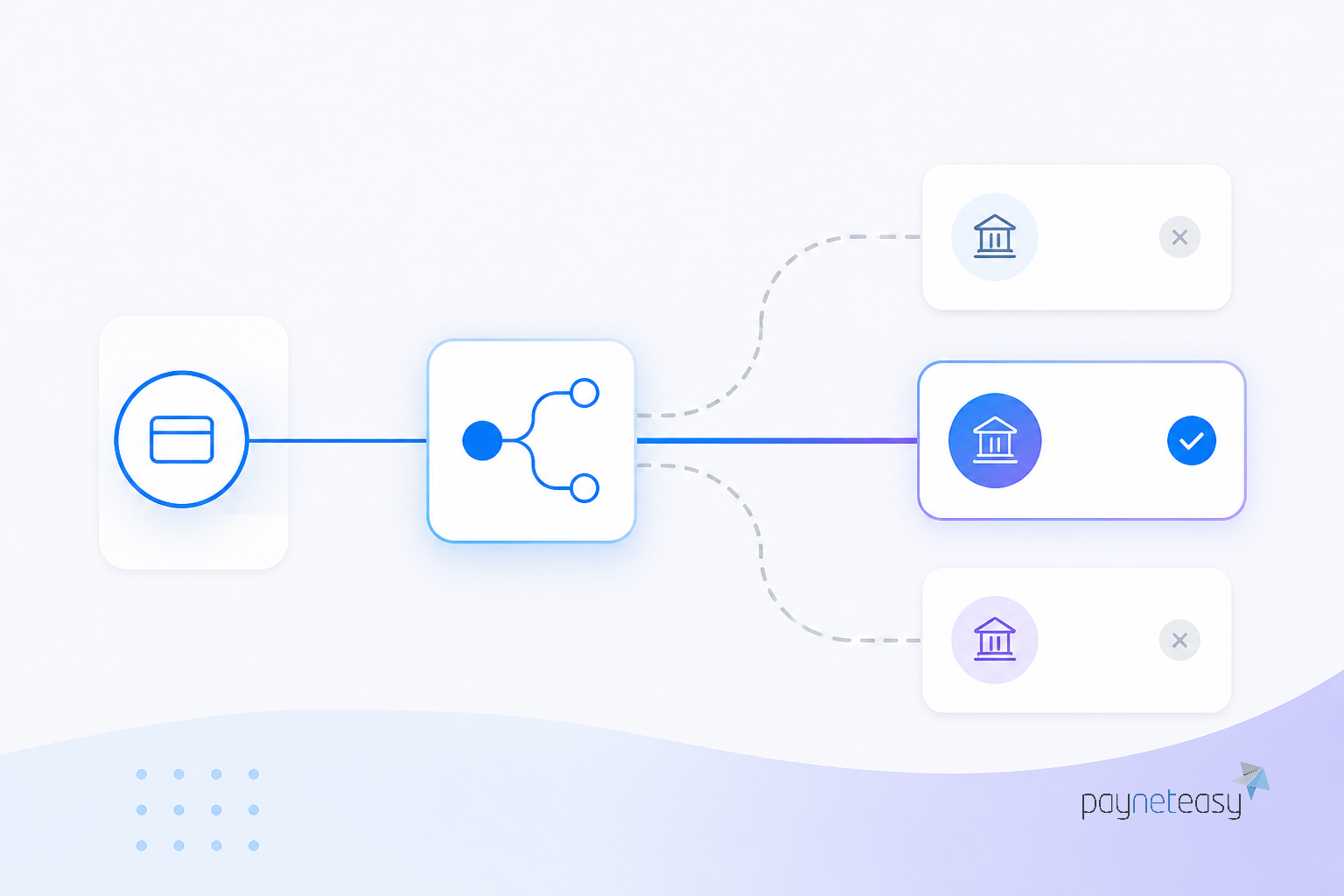
The role of payment orchestration platforms
These routing strategies need a control system, which is the role of a payment orchestration platform. It gives the PSP or merchant a technology layer above individual provider connections. That layer manages payment flows, routing, cascading, reporting, reconciliation, and operational visibility across active PSP and acquirer connections.
This matters because direct integrations do not scale cleanly for high-risk payment operations. Every new provider connection can create engineering work and ongoing maintenance. It also adds monitoring requirements and data mapping work for reconciliation. When provider APIs change, the burden returns. When a merchant needs another payment path, the delay is operational rather than theoretical. The business may have a willing provider, but the route is not useful until it is connected and tested.
McKinsey's view that payments value is shifting toward dynamic routing and the control layer of trust fits what PSP teams see in practice. The checkout screen is only one part of the system. The harder work sits behind it: deciding where to route the transaction, reading the response, applying risk controls, maintaining provider connections, reconciling settlement, and giving operations enough data to act.
A useful orchestration platform does not remove the need for payment judgment. It gives the team a better place to apply it. Payment leaders still decide which PSP and acquirer relationships make sense and which merchants qualify for which routes. They also decide how chargeback exposure is handled and which decline patterns should trigger fallback routing. The platform should make those decisions executable and visible.
Payneteasy provides this kind of payment technology layer through its Payment Gateway and Orchestration Platform, including advanced routing and cascading, reporting, reconciliation, and support for high-risk PSP payment flows. The platform is PCI DSS Level 1 compliant, has more than 1,000 integrations, offers Payment Channels to connect PSPs with merchant payment systems, with timelines depending on documentation readiness, integration scope and testing, handles up to 10 million transactions per day, and reports 99.95% platform uptime, tracked by Pingdom since April 2022. Those points matter most when the PSP is trying to add coverage without making every provider connection a new internal engineering project.
For readers comparing basic routing rules with adaptive decisioning, the next deeper guide on Intelligent Payment Routing explains how routing can move beyond fixed rules while still requiring operational control.
Next steps: implementing a routing strategy
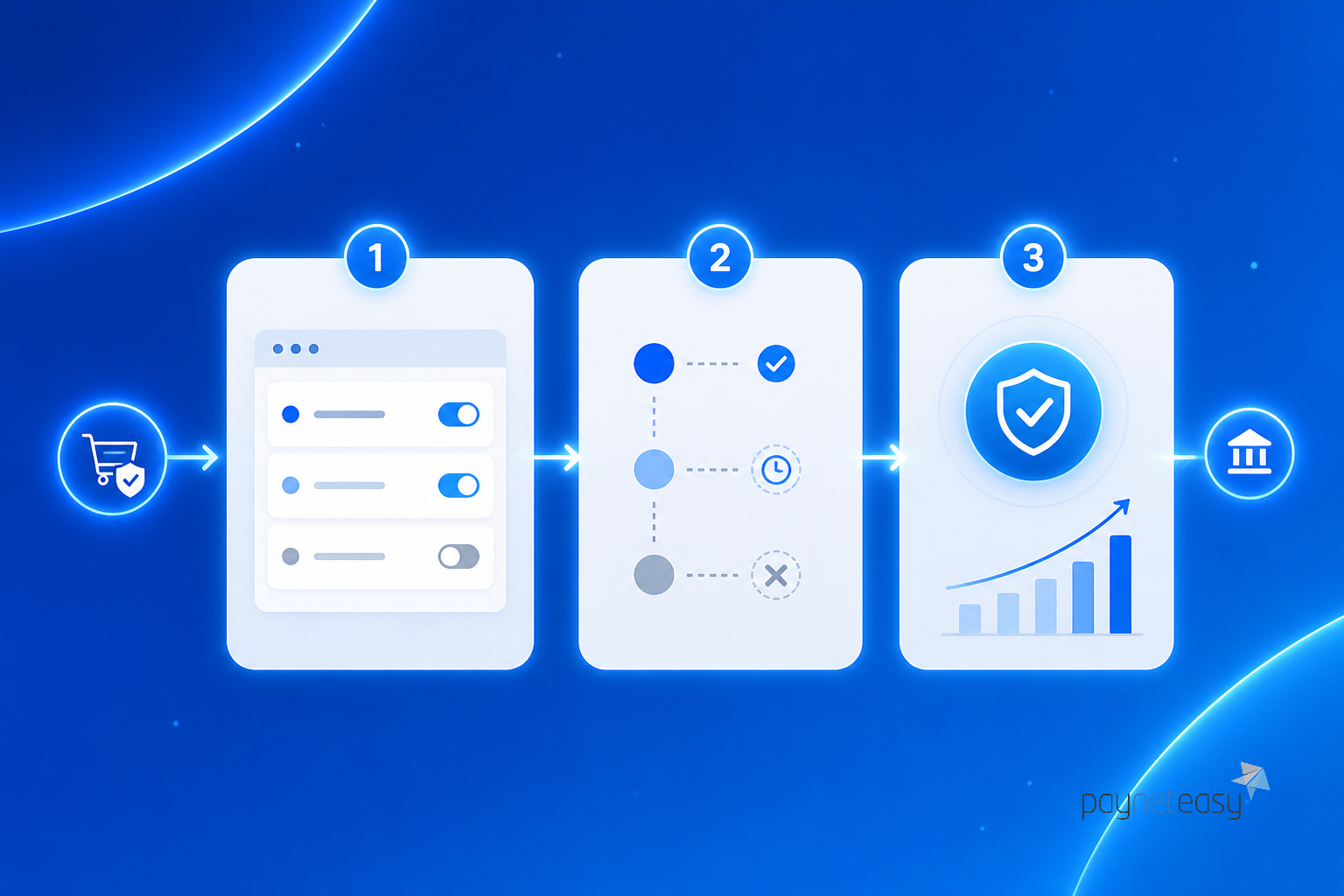
The practical starting point is the current payment flow, not the tool. A high-risk PSP should map which merchants use which provider connections and where approval rate changes are visible. The same review should identify which decline codes are actionable, which countries or card BIN ranges create pressure, and where settlement or reconciliation issues slow operations.
The next step is to separate missing coverage from poor diagnosis. If the team cannot break performance down by provider, route, country, card BIN, and decline code, it may move traffic before it understands the pattern. That can create new problems. The better sequence is to identify the weak segment, confirm whether the issue is technical, risk-related, issuer-related, or provider-specific, then adjust routing with a narrow rule.
After that, check backup capacity. A fallback route should be live and connected, with testing complete and operations able to manage it before it is needed. If a provider connection exists only as a contract or an unfinished integration, it does not protect payment coverage. Use a connection readiness checklist to confirm the route can actually carry volume, report correctly, reconcile cleanly, and support operations during a payment issue.
Payneteasy can fit this work where a PSP needs a white-label payment gateway technology layer, payment orchestration platform, or Payment Channels coverage for additional PSP connections. The important decision is not whether routing sounds useful. It usually does. The real decision is whether the PSP has enough live connections, clean enough data, and disciplined enough rules to route payments without guessing.