What are cascading payments and why do they matter?
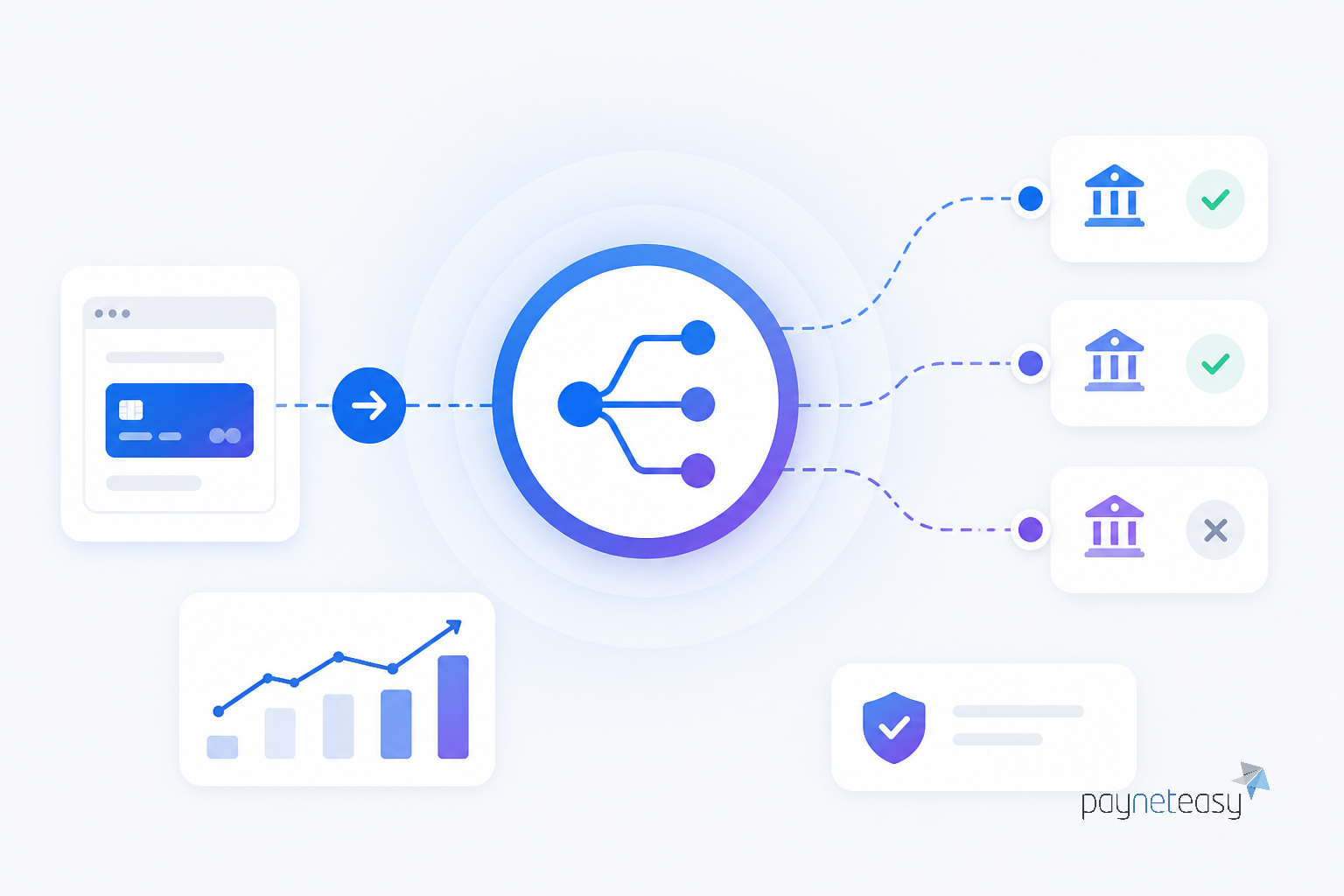
A high-risk PSP usually sees the need for cascading in operations before it sees it in a roadmap. One provider connection starts declining valid traffic, a merchant asks where the backup route is, and the payment team has to keep volume moving while the root cause is still unclear. Cascading payments handle that specific failure pattern by rerouting failed transactions through alternative payment gateways or acquirers, which helps maintain payment coverage and supports approval rate when a primary route cannot complete the payment.
How cascading payments work
The basic flow is straightforward. A transaction goes to the primary route. If it fails for a reason your rules treat as recoverable, the payment flow moves to another live provider connection or acquirer connection. That second route must already be connected and verified, with management available inside your payment technology, because a backup route that still needs engineering work is not backup capacity.
The operational reason matters. At PSP level, the same pattern is smaller but familiar: one weak route can affect merchant approval rate and the work around reporting and reconciliation, as well as settlement planning.
Cascading vs. retry: a key distinction
A retry usually sends the same payment attempt back through the same route, often after a timing issue. Cascading changes the route. That distinction is why it belongs in payment orchestration rather than basic error handling.
Prerequisites for implementing a cascading system
Before you configure cascading, confirm that the payment infrastructure can actually support it. The starting point is live coverage, not a diagram. A cascade only works if the PSP has more than one usable path for a transaction, which means active provider connections or acquirer connections with known capabilities, limits, reporting behavior, and settlement expectations. Your operations team should know which connections are ready for volume, which are still being tested, and which should be reserved for specific merchant categories or payment flows.
Before touching routing rules, document your provider connection readiness. The checklist should cover technical availability, credentials, test results, decline-code visibility, reconciliation format, chargeback reporting, and the internal owner who can approve changes. If a route is technically connected but no one trusts its reporting or settlement output, it is not ready for a cascade.
You also need a gateway layer that can manage multiple routes under your own operating model. For a high-risk PSP, a white-label payment gateway is often the control point for merchant onboarding, routing, transaction visibility, and branded reporting. The PSP keeps its own acquirer relationships and underwriting model, but the payment technology needs enough control to move traffic without asking engineering to rebuild the flow during an incident.
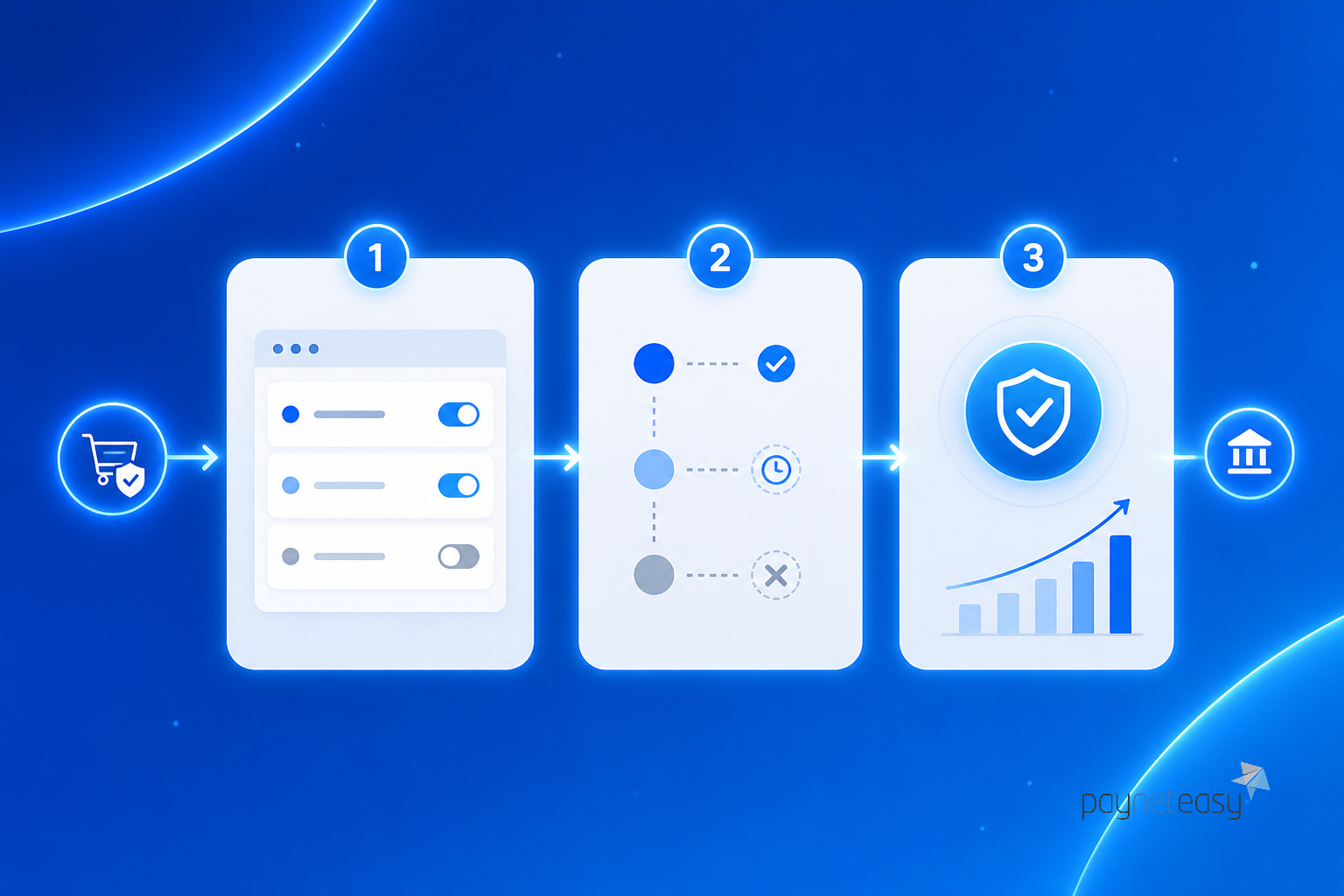
Step 1: Map your existing payment infrastructure
Once the prerequisites are clear, map the routes you already depend on. This step matters because payment teams often overestimate their backup capacity. A PSP may have several integrations listed internally, but only two may be live for a given merchant segment, one may lack the right currency coverage, and another may produce reporting that operations cannot reconcile without manual work. Cascading logic built on that kind of uncertainty creates noise instead of resilience.
Build a route inventory by merchant segment, not only by provider name. For each active route, capture the payment methods, countries, currencies, transaction types, merchant categories, chargeback reporting path, settlement file format, and known operational constraints. Then mark which routes are approved for primary traffic, fallback routing, testing only, or no traffic.
A practical route map can be simple:
Merchant segment: gaming
Primary route: acquirer connection A
Fallback route 1: provider connection B
Fallback route 2: acquirer connection C
Do not cascade to: provider connection D, reporting not reconciled
Owner: Head of Payments
Review cycle: weekly during volume changes

The output of this step should be a clear view of single points of failure. If one merchant segment has only one live path, there is no real cascade yet. If two routes exist but only one has usable decline-code reporting, your routing decision may be blind. Fix those gaps before writing rules.
Step 2: Define your cascading and routing logic
After the route map is accurate, define the logic that decides when a failed transaction should move and when it should stop.
The reason comes before the rule syntax. Cascading is useful only when it sends the right failed transactions to the right fallback route. If every decline is cascaded without judgment, the PSP can create duplicate attempts and higher latency, along with messy reconciliation and risk-control problems. Good routing starts by separating failures that may recover on another route from failures that should stop.
Use decline response, BIN attributes, merchant profile, transaction value, payment method, geography, and route health as inputs. Keep the first version narrow. For example, you might cascade selected technical declines or confirmed route failures where another attempt is permitted, while stopping on declines that prohibit a retry. A timeout or communication failure does not necessarily mean the payment failed. If the original attempt’s status is unknown, resolve it through status checks and the provider’s recovery procedure before submitting another payment attempt. Your exact categories depend on the decline data your providers return and how consistently your team can interpret it.
A rule table is often easier to govern than a large decision tree:
If primary route fails because route is unavailable:
  send to fallback route 1

If primary route returns selected recoverable decline:
  send to fallback route 2

If decline indicates do not retry:
  stop cascade and return final status

If fallback route fails:
  stop after configured attempt limit
For a deeper routing design, connect this step to your broader intelligent payment routing model. Cascading is one branch of routing. It should sit beside load balancing, merchant-level routing, provider health checks, and approval-rate monitoring, rather than operating as a separate rule set no one reviews.
The rule owner should be a payment leader, not only an engineer. Engineering can configure the logic, but operations must understand how a failed transaction moves, where reporting lands, and what the merchant sees.
Step 3: Configure your fallback routes in a payment gateway
Once the logic is defined, configure it inside the payment technology that controls the payment flow.
The goal is to turn the route map and rule table into a controlled operating setup. In most gateway environments, that means creating route groups, setting a primary route, assigning fallback routes, defining stop conditions, and limiting the number of attempts. Do not begin with every possible combination. Start with one merchant segment where the route inventory is clean and the reporting path is understood.
In the gateway interface or configuration layer, the structure should read like an operating decision:
Route group: high-risk merchant segment A
Primary: route 1
Fallback: route 2
Second fallback: route 3
Cascade trigger: selected recoverable failures
Stop condition: final decline, attempt limit, risk rule, missing route
Reporting tag: cascade_group_A
A platform such as Payneteasy can support this through routing and balancing across acquirer and provider connections, including advanced routing and cascading. Through Payment Channels, Payneteasy states that a PSP connection can typically be enabled in 5–7 business days when documentation is ready upfront; complex cases may take longer. The platform offers more than 1,000 existing integrations. The same payment technology is built for up to 10 million transactions per day and 99.95% verified uptime.
After configuration, run controlled tests before moving merchant volume. Confirm that the second route receives only the transactions you expect, that duplicate captures are not created, that transaction IDs can be traced across attempts, and that reconciliation shows the final status clearly.
Troubleshooting common cascading payment issues
Once the cascade is live, the main work shifts from configuration to control. Most problems are operational, and they usually show up in transaction history, latency, decline handling, or finance reports.
The first issue is a routing loop. This happens when a failed transaction keeps moving between routes without a clear stop condition. The fix is an attempt limit, a final-decline rule, and route-level exclusions so a transaction cannot return to the same failing path under a different label. You can tell the fix worked when each transaction has a single final status and a readable attempt history.
The second issue is latency. Each extra route adds time, and some merchant categories are sensitive to slow checkout response. Track total authorization time by cascade group, not only by provider. If approval gain is small and checkout time increases materially, narrow the triggers rather than cascading every recoverable-looking failure.
The third issue is inconsistent decline handling. Different provider connections may return different response formats for similar situations, which can cause the cascade to treat one provider's final decline as another provider's recoverable failure. Normalize decline categories inside your reporting layer before expanding volume. The World Bank's 2022 warning about payment inefficiencies creating cascading effects throughout the economy is broad, but the operational lesson is direct: small payment flow errors compound when they are automated.
The fourth issue is reconciliation drift. A transaction may fail on the first route and succeed on the second, but your merchant report must show one clear payment outcome. If finance needs manual matching, the cascade is not production-ready. Add reporting tags for route group, attempt number, final route, and final status.
Building a resilient, future-ready payment infrastructure
Troubleshooting is where a cascading setup becomes operational discipline rather than a gateway setting. A working cascade is visible before, during, and after a payment issue. The PSP has live backup routes in place, operations can see why a transaction moved and where it ended, and merchants get continuity without losing clarity in reporting and settlement, or in chargeback handling.
As of 2025, industry discussion has moved beyond disaster recovery toward payment resilience, which fits how high-risk PSPs already operate. Payment coverage is never finished. New acquirer and provider connections keep appearing, along with merchant requirements, so cascading should be treated as an operating practice, not a one-time configuration task.
The natural next step is to decide where gateway routing ends and payment orchestration should take over. If your team can answer which route takes volume when the primary path fails, how that decision is logged, and how finance reconciles the result, the cascade is doing its job.