What is intelligent payment routing?
Intelligent payment routing is the use of rule-based logic and algorithms to choose the best available path for a transaction across multiple payment providers. A high-risk PSP usually feels the need for it when payment coverage has to expand or a merchant needs another payment path. It can also be needed when a backup route has to be ready before a payment issue reaches live traffic. The routing layer directs transactions through the payment channel most suited to the PSP's objective for that flow. That objective may be approval performance, cost control, risk handling, or continuity.
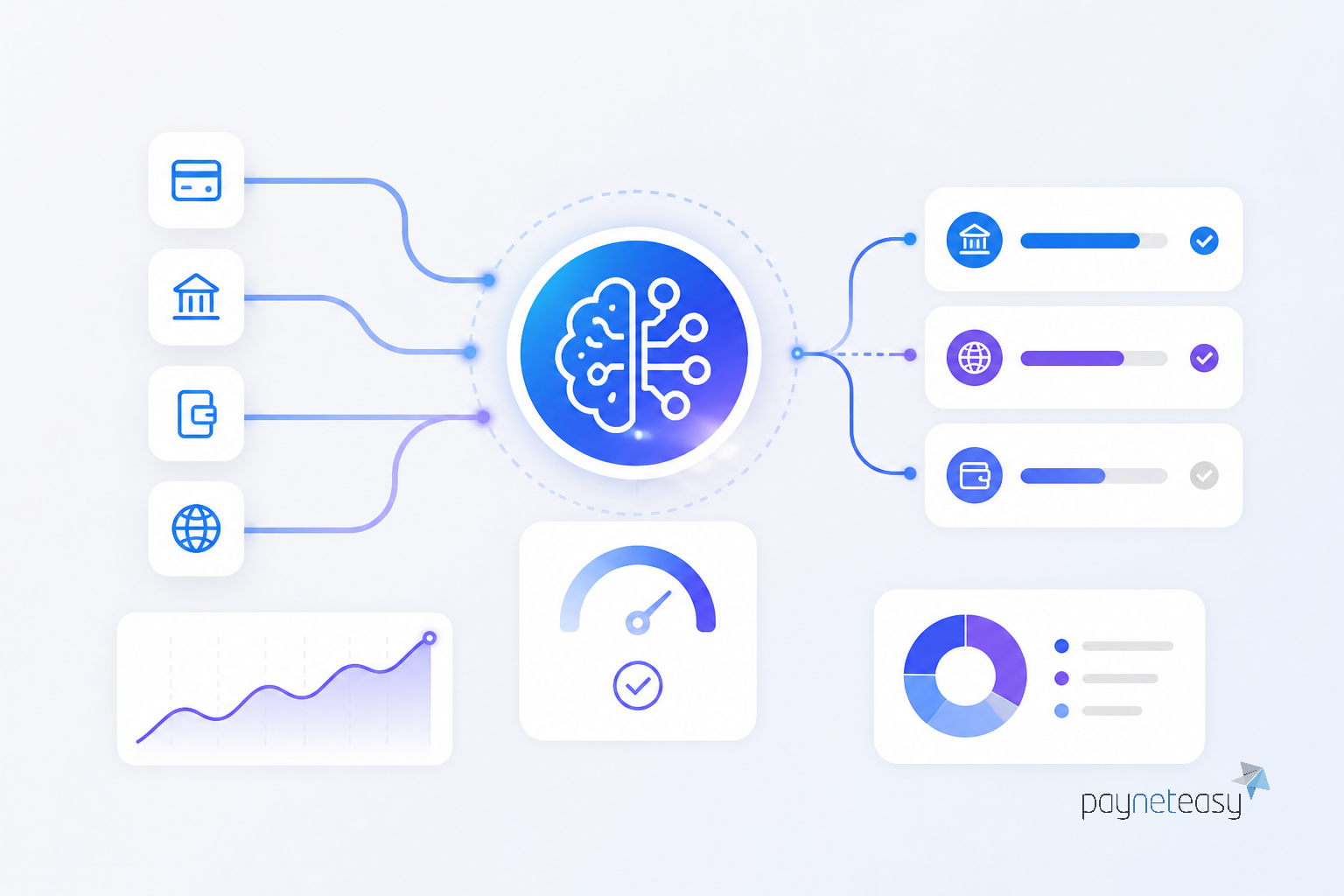
The basic idea is simple. Instead of sending every transaction through one default provider connection, the payment orchestration platform evaluates the transaction and selects a route based on the PSP's operating goal. That goal may be approval rate or cost. It may also involve risk control, geographic coverage, issuer performance, settlement requirements, or backup capacity.
The value depends on having more than one live path. Depending on the configuration, routing rules and balancing logic can use transaction attributes, provider limits, and historical processing results to select among connected payment paths. For a high-risk PSP, that matters because one merchant portfolio can contain different countries and card types. Risk levels, settlement needs, and chargeback profiles can also vary across the same portfolio. A single static route rarely fits all of them.
In practice, intelligent payment routing sits inside payment orchestration platforms, white-label payment gateway technology, or a routing and balancing layer connected to the PSP's provider and acquirer network. It does not remove the need for acquirer relationships or merchant underwriting. Reconciliation and reporting discipline still matter. It gives payment operations a more controlled way to use live provider connections, so traffic is not trapped behind one path when performance drops or a provider connection has downtime.
For high-risk PSPs, the working question is whether the payment infrastructure has enough live, verified, manageable coverage for the next merchant, the next country, and the next payment issue.
Core concepts: routing vs. cascading
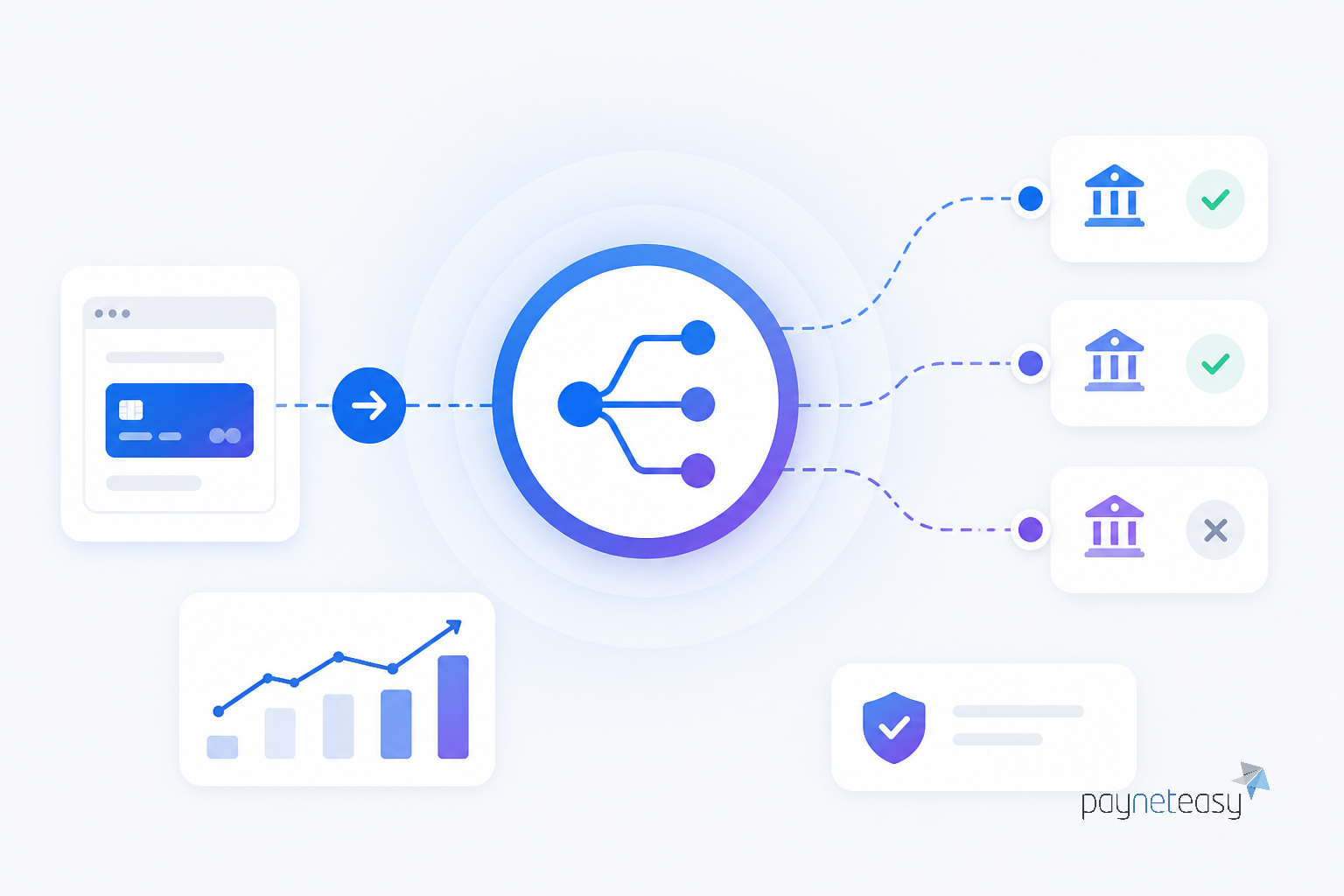
Once the definition is clear, the next distinction is operational: routing and cascading solve different problems. Standard cascading, sometimes called waterfall routing, is usually reactive. A transaction is attempted through the first configured route. If that attempt fails for an eligible reason, the system tries the next route in the sequence. The next route may follow a configured priority or a dynamically ordered chain. A new attempt should be sent only when the first attempt’s outcome and the reason for failure allow it.
Unlike reactive cascading, IPR proactively chooses routes based on criteria like approval performance, cost, risk, or geographic factors before the first attempt. Those attributes may include issuer behavior, geography, and cost. Cross-border handling, fraud indicators, and the provider's prior performance for similar traffic may also guide the decision. Routing determines the initial path. Cascading or failover rules govern what happens after that path fails.
The difference shows up during payment operations. Cascading asks where to send a transaction after the first path fails. Intelligent payment routing asks which live path gives the transaction the strongest chance of meeting the PSP's objective from the start. That objective changes by flow. A low-risk domestic card may be routed for cost. A high-risk cross-border transaction may be routed for approval rate and risk controls. A merchant with urgent continuity needs may require fallback routing that keeps traffic moving when the primary provider has downtime.
System resilience improves when fallback mechanisms route transactions to alternatives when primary providers experience downtime. Approval rate can also improve when transactions are routed to providers with stronger issuer relationships or better performance in specific regions. Cascading remains useful, but intelligent routing decides how the PSP uses the full set of available routes.
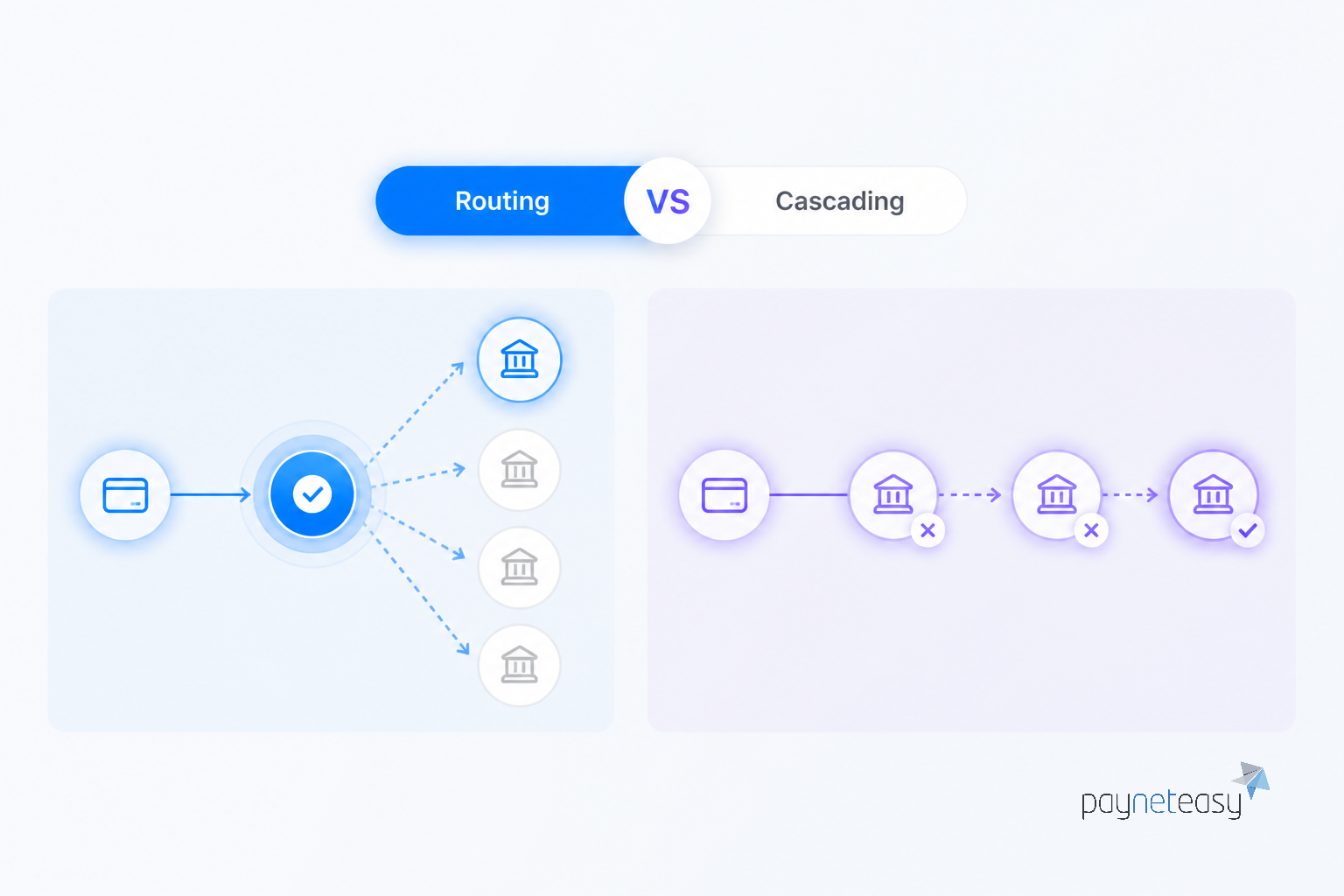
Key IPR terminology for payment operations
Before a PSP can govern routing rules, payment operations needs shared terminology. Teams often use the same words in different ways, and that creates confusion when routing rules are discussed during a live incident.
Payment route is the configured path used to send a payment attempt to an eligible provider or acquirer connection. Merchant settings, fraud checks, and authentication can affect route selection; the resulting transactions must also be tracked through reporting, reconciliation, and settlement.
Provider connection is a technical connection to a PSP, gateway, processor, acquirer, or other payment provider used to move a transaction through a defined payment channel. A connection is useful only when it is live, verified, monitored, and manageable by payment operations.
Acquirer connection refers to the path into an acquiring relationship used for card acceptance. A high-risk PSP may operate with multiple acquirer connections to support different merchant categories, regions, currencies, and risk profiles.
Cascading is logic for sending a payment to another eligible route after an initial attempt fails, when the decline reason, applicable scheme rules, and PSP rules permit another attempt. A timeout requires a status check and duplicate-payment controls before a new authorization request.
Fallback route is a ready alternative path. It is not a theoretical integration in a backlog. It must be connected before a payment issue, with clear rules for when traffic can move to it.
Routing rule is a condition that tells the platform how to direct traffic. A rule may use geography, payment method, currency, BIN range, transaction amount, merchant category, provider health, approval rate, cost, or risk indicators.
Payment orchestration is the control layer that manages multiple providers, routing, reporting, reconciliation, and payment flows from one operational environment.
Approval rate is the share of attempted transactions that are approved. It is influenced by issuer behavior, provider performance, fraud controls, authentication, transaction data quality, and routing decisions.
How intelligent routing strategies drive performance
With the core terms in place, the next point is strategy. Intelligent payment routing is not one rule that improves every payment flow. It is a set of operating choices. A high-risk PSP may use one routing strategy for a low-risk recurring subscription merchant, another for gaming traffic with heavy cross-border volume, and another for a merchant that needs backup capacity during provider maintenance. The platform logic has to follow the payment operation's objective, not force the operation into a generic route order.
Least-cost routing
Least-cost routing sends eligible transactions through the path expected to reduce processing cost. In card payments, that can mean choosing a route based on geography and cross-border fees. Currency handling or provider pricing can also shape the choice. For cross-border traffic, a PSP can compare the cost of eligible routes, including provider pricing, currency handling, and applicable cross-border charges, alongside their authorization and settlement performance.
Cost routing needs discipline in high-risk portfolios. The cheapest route on paper may be a poor route if it increases declines, creates reconciliation problems, or moves traffic into a provider path that cannot support the merchant's risk profile. Cost is one input. It should not override approval behavior, settlement reliability, reporting quality, or risk controls.
For a PSP, least-cost routing is most useful where the transaction is eligible, the provider can handle the traffic cleanly, and the cost saving does not create a larger operational loss elsewhere.
Success-rate routing
Success-rate routing directs transactions toward provider or acquirer connections that have stronger performance for a specific transaction type. The decision can be based on card issuer, issuing country, payment method, currency, merchant category, amount band, or previous authorization behavior.
The logic is practical. Some providers perform better with certain issuers. Some routes perform better in certain regions. Authorization performance can differ by issuer, region, merchant segment, and acquirer connection. Routing can use comparable historical results to favour an eligible path, while respecting provider limits, risk restrictions, and settlement requirements.
For high-risk PSP operations, success-rate routing is often where the routing layer proves its value. A merchant may complain that "cards are failing," but the real issue may sit at the intersection of BIN range, issuing country, transaction amount, authentication result, provider health, and acquirer behavior. A static route hides that pattern. A richer routing layer can expose it and act on it.
Success-rate routing still needs guardrails. Payment operations should avoid pushing all volume to the provider that performed best in a short sample. The route may have capacity limits, risk limits, settlement constraints, or monitoring thresholds. A serious routing setup balances approval performance with provider coverage, risk appetite, and continuity.

Risk-based routing
Risk-based routing directs transactions based on risk signals. Those signals can include geography, merchant category, card attributes, chargeback exposure, fraud indicators, authentication results, velocity, amount, or customer behavior. The goal is not to promise fraud elimination. The goal is to apply the right level of routing control to the right payment flow.
Risk-based routing works within the PSP’s underwriting, fraud, authentication, and acquirer restrictions. Risk signals can help determine which routes are eligible for a payment. Fraud screening and authentication remain separate controls, even when their results inform the routing decision.
This matters for high-risk PSPs because merchant portfolios are not uniform. A forex merchant, gaming merchant, subscription merchant, and digital goods merchant can all sit under the same PSP, but their payment flows may carry different chargeback patterns, refund behavior, settlement needs, and fraud pressure. Intelligent payment routing lets the PSP avoid one blunt rule across all flows.
Risk-based routing also protects provider relationships. If payment operations can identify which traffic belongs on which route, the PSP is less likely to overload a sensitive acquirer connection with traffic that should have been controlled or redirected. That protects continuity and gives reporting and reconciliation teams clearer data when they investigate declines, disputes, or settlement differences.
Key benefits for high-risk PSP payment operations
The strategies only matter if they improve daily payment operations. The first direct benefit is coverage that can be used under pressure. A backup route has little operational value if it exists only as an unfinished integration or a commercial conversation. It has value when it is live, connected, tested, and manageable in the same operational view as the primary route.
Automatic fallback is the clearest resilience case. When a provider becomes unavailable, configured failover rules can direct new transactions to another live, eligible route. If an in-flight attempt has an unknown outcome, payment operations must establish its status before retrying it. For a high-risk PSP, this is core operating capacity. A provider issue can hit merchant revenue, support tickets, chargeback pressure, and trust in the PSP's payment technology. The first operating question is which connection can take the traffic next.
The second benefit is better performance visibility. A routing layer only improves operations if the team can see what happened. In an ACI Worldwide survey of retail payments professionals published in 2026, 47% selected access to richer payments performance data across channels as a relevant benefit of orchestration. For a PSP, the practical requirement is reporting that separates results by merchant, provider, issuer, market, and payment method.
Unified dashboards can bring payment operations data into one view, which helps teams pinpoint failed transactions and top-performing providers. The same view can also expose cost-saving opportunities. For a PSP serving high-risk merchants, that visibility supports routing, merchant onboarding, and provider review. It also helps with chargeback analysis, settlement checks, and discussions with technical teams about where engineering time should go.
The third benefit is uptime discipline. A white-label payment gateway with 99.95% verified uptime gives the PSP a stronger foundation for routing and fallback operations, but uptime at the platform level does not remove the need for route-level monitoring. Provider connections can still degrade. Acquirer behavior can still change. Fraud controls can still block good transactions if rules are too blunt.
That is why intelligent payment routing belongs in the same conversation as a high-risk payment gateway. The PSP needs gateway infrastructure, orchestration logic, reporting, reconciliation, and backup capacity to work together. If those functions are split across too many disconnected tools, payment operations loses time exactly when it needs clarity.
The honest trade-off is complexity. More provider connections and more routing rules create more operational surface area. The answer is stronger rule governance, clearer dashboards, verified backup routes, and a payment operations team that knows which objective each rule is serving.
When is intelligent routing most critical?
Those benefits become critical in specific operating scenarios. The first is expansion. When a PSP starts supporting more merchants or more countries, static routing becomes fragile. The same is true when it adds more currencies or more payment methods. As coverage expands, routing rules need to account for the payment methods, provider eligibility, currencies, and performance patterns of each new market.
The second scenario is high transaction volume. A gateway that can handle up to 10 million transactions per day gives a PSP room to operate at scale, but high volume makes routing mistakes more expensive. A weak rule can send too much traffic into a poor-performing path. A missing fallback route can expose many merchants at once. A reporting gap can delay root-cause analysis because the team cannot quickly isolate the provider, issuer, market, or risk pattern behind the issue.
The third scenario is high-risk merchant coverage. High-risk merchants often need more than one payment option because approval behavior, risk controls, and provider appetite can change. A PSP serving these merchants needs backup routes ready before they are needed. Intelligent payment routing gives the PSP a structured way to decide where each payment flow should go, rather than treating every transaction as identical.
The fourth scenario is incident response. When traffic fails, payment operations should not spend the first hour asking whether another path exists. The route should already be connected. The routing rules should already define what can move, under what conditions, and with what reporting. Root-cause analysis still matters, but continuity comes first.
Implementing your payment routing strategy
After the PSP identifies where routing matters most, implementation should start with current payment coverage rather than a feature list. Map each merchant segment against live provider connections and acquirer connections. Then add countries, currencies, payment methods, approval rate patterns, settlement requirements, chargeback exposure, and known fallback routes. The gaps in that map are the real routing backlog.
Then define the purpose of each rule. Some rules should protect approval rate. Some should control cost. Some should keep risky traffic away from routes that are not suited to it. Some should preserve continuity when a provider connection fails. If a rule has no clear operational reason, it will be difficult to defend when traffic behaves unexpectedly.
Payneteasy reports more than 1,000 existing integrations. For a high-risk PSP, the useful measure is which connections are live, eligible for its merchants, tested, and manageable by payment operations. Routing can select only among paths that are actually available for the relevant payment flow.
If you are ready to move from the concept to the operating model, use a deeper guide to develop a routing strategy that connects rules, provider coverage, fallback routing, reporting, and reconciliation. Intelligent payment routing is useful only when it is governed as payment infrastructure, with rule ownership, monitoring, and operational review built into the process.