Why you need a decision matrix for payment orchestration
A high-risk PSP usually starts this exercise when payment coverage is under pressure. One high-risk merchant needs another payment path. Operations wants a backup route ready before traffic is affected. Or one acquirer connection has become too important to run without fallback routing. A decision matrix turns that pressure into weighted criteria and scores each payment orchestration platform against the same evidence, giving the payment team and its risk and engineering counterparts a defensible way to choose.
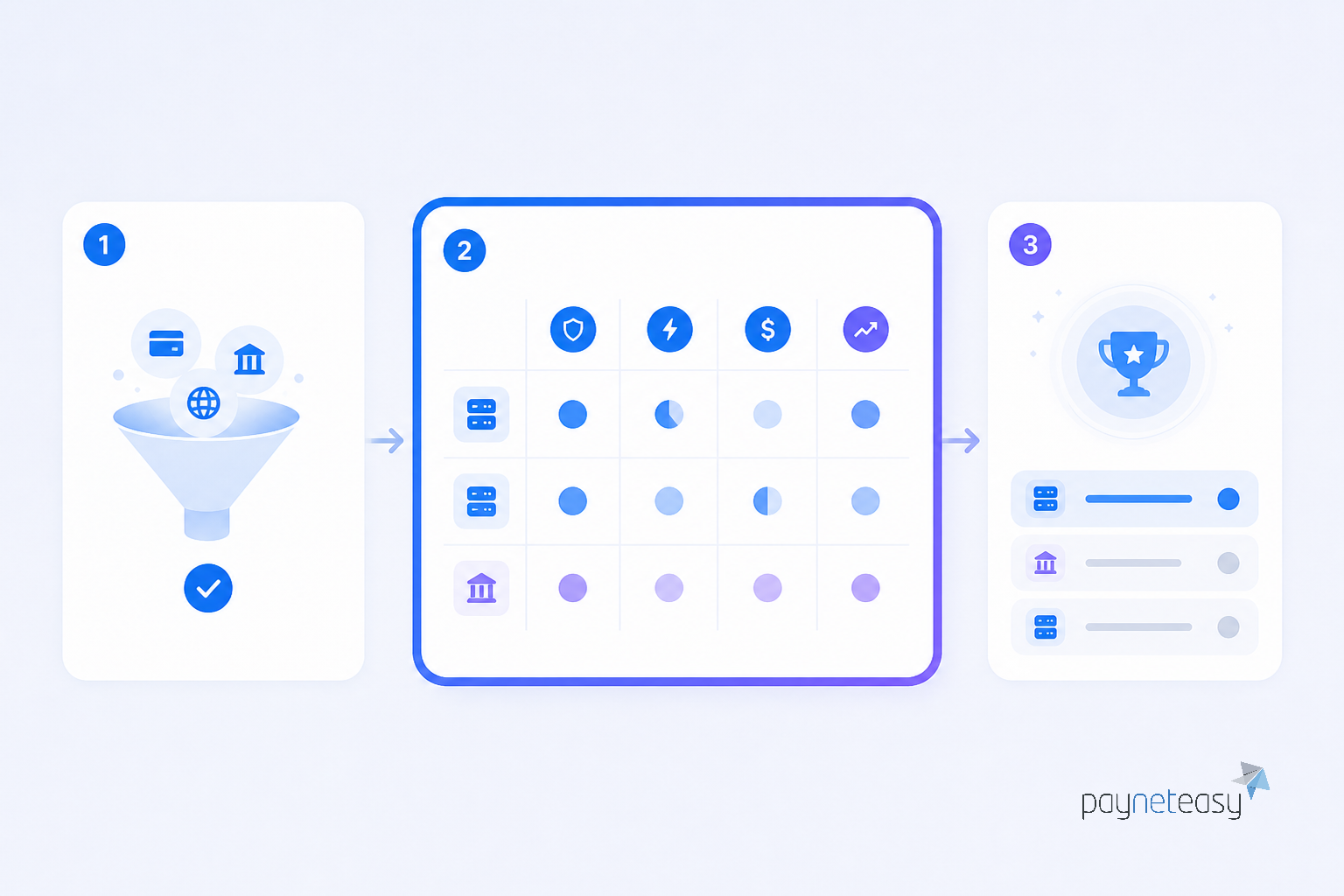
To build a useful PSP payment gateway orchestration decision matrix, define the criteria that matter to your payment operations, such as integration speed and routing control, along with reliability. Then assign weights based on the business trigger, score each platform against evidence, and compare the weighted totals. The friction is that every stakeholder sees risk from a different angle. Payments cares about approval rate and backup capacity. Engineering cares about integration time and maintenance load. Operations cares about reporting and reconciliation, plus incident handling. The matrix keeps those views in one operating document, so the decision does not drift toward the loudest preference in the room.
Prerequisites: what you need before you start
Before building your matrix, you need to gather specific information. Start with your current payment flows, including live provider connections, acquirer connections, fallback routes, currencies, merchant segments, and transaction types. The matrix should reflect the payment infrastructure you operate, not a generic wish list.
You also need internal agreement on the business trigger. For a high-risk PSP, that trigger is usually one of four things: more payment coverage is needed, a merchant needs another route, backup capacity must be ready before a payment issue, or operations needs better visibility into a payment problem. Write that trigger at the top of the worksheet, because it will decide the weights later.
Bring the right people into the first scoring session: Head of Payments, CTO or lead payment engineer, risk or chargeback owner, merchant onboarding lead, and someone responsible for settlement and reconciliation. You do not need contract terms or legal advice to build the matrix. You need operating facts.
Step 1: identify your core evaluation criteria
With the prerequisites in place, define what you will measure before you speak with platform vendors. If the vendor controls the scorecard, the discussion follows the demo path instead of your payment operations. Your criteria should describe the capabilities your PSP needs to keep traffic moving across active routes and backup routes.
Technical capabilities
Start with integration speed, API coverage, routing logic, cascading, uptime, reporting access, reconciliation support, and the amount of engineering time required to add and verify a new provider connection. For a high-risk PSP, a connection that exists only as a roadmap item should not score the same as one that is live and tested, with management available through the platform.
Use a short list at first:
| Criterion | What you are checking |
|---|---|
| Integration speed | Time to add and verify a PSP or acquirer connection |
| Routing control | Ability to direct payment flows by merchant, market, amount, risk signal, or provider status |
| Reliability | Uptime, incident handling, and operational visibility |
| Reporting | Transaction, settlement, reconciliation, and chargeback views |
Business and operational fit
After the technical rows, add the criteria that decide whether the platform fits daily PSP operations. This includes merchant onboarding, operational permissions, support model, reporting depth, and whether the platform can sit under your PSP brand as white-label payment gateway technology. Keep this practical. If operations cannot see what happened to a payment issue, the platform creates hidden work even when the integration looks clean.
High-risk specific functionality
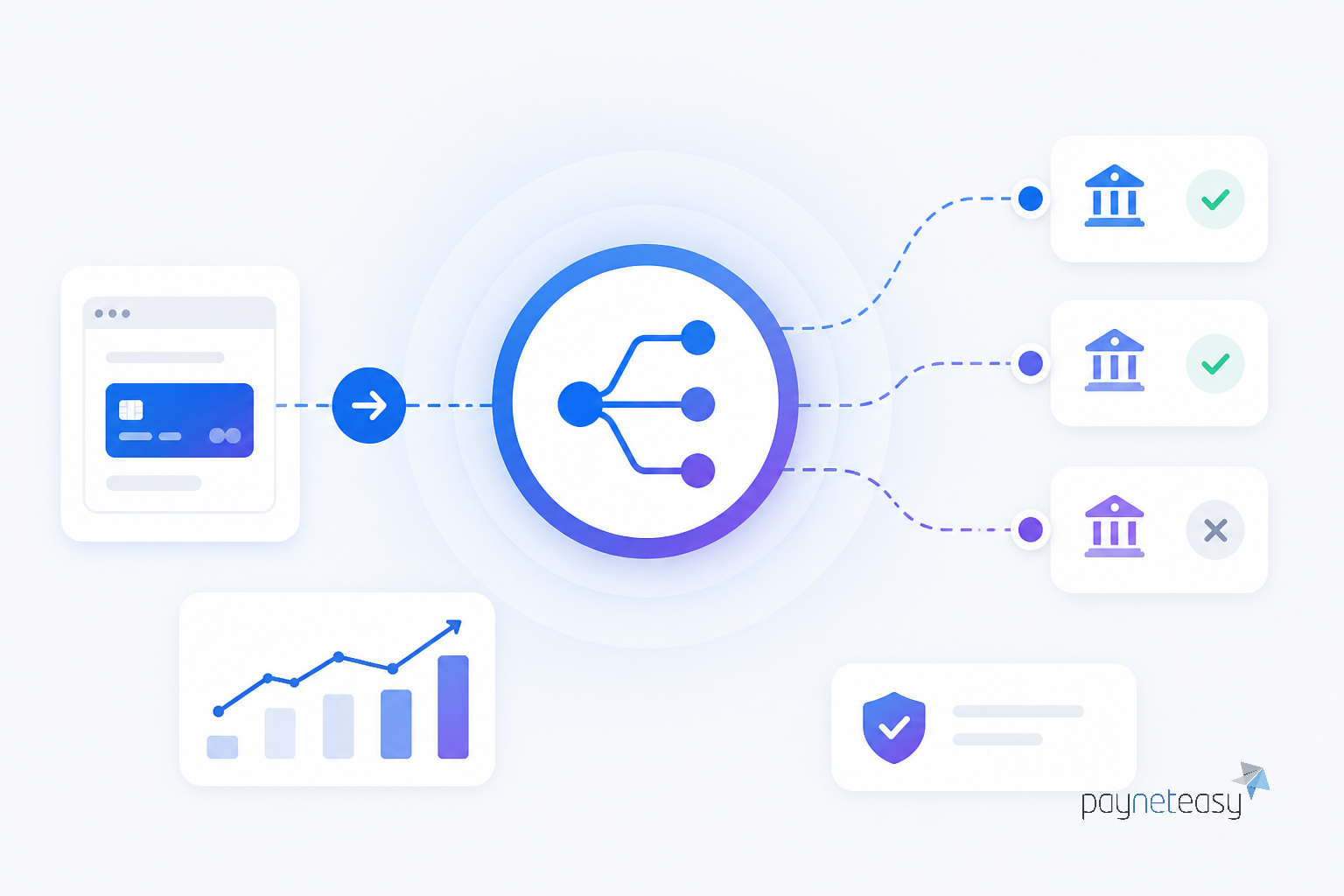
Then add the criteria specific to high-risk payment operations. That means backup routes, fallback routing, chargeback visibility, 3DS handling where relevant, and support for high-risk merchants without forcing every exception into engineering. These capabilities decide whether payment coverage is usable under pressure. Coverage on paper does not help much if the backup route is not live and connected, with management available when a provider connection starts failing.

Step 2: assign weights based on business priorities
Once you have the criteria, decide how much each one matters. Equal weights can look neutral, but they often hide the real business decision. A high-risk PSP trying to reduce exposure from one dominant acquirer connection should weight backup capacity and routing higher than dashboard preferences. A PSP with limited engineering capacity should give integration speed and operational configuration more weight.
Use a 100-point weighting model. It is simple enough for stakeholders to understand and strict enough to force trade-offs. For example:
| Category | Weight |
|---|---|
| Integration speed and connection depth | 25 |
| Routing and fallback control, including cascading | 25 |
| Uptime and operational reliability | 20 |
| Reporting and reconciliation, with settlement visibility | 15 |
| Merchant onboarding and white-label fit | 10 |
| Chargeback and risk operations support | 5 |
Change the weights if the trigger points somewhere else. If chargeback exposure is the main operational problem, risk operations may deserve more than 5 points. If merchant onboarding is the bottleneck, raise that category and lower something less urgent.
The useful test is whether the weights would still make sense during an incident. If a route fails and your first question is, "Which live connection can take the volume next?", routing and verified backup coverage should carry enough weight to affect the final score. If they do not, the matrix is describing a preference rather than an operating requirement.
Step 3: score and compare potential platforms
Now apply the framework to each potential partner. The point of scoring is not to create a complex procurement artifact. It is to make every platform answer the same operational questions, on the same scale, before opinions harden around a preferred option.
Use a 1 to 5 score for each criterion:
| Score | Meaning |
|---|---|
| 1 | Does not meet the requirement |
| 2 | Partially meets it, with material operational workarounds |
| 3 | Meets the baseline requirement |
| 4 | Meets the requirement with strong operational fit |
| 5 | Exceeds the requirement in a way that matters to your payment flows |
Then multiply each score by the weight. If routing control has a weight of 25 and a platform scores 4, it earns 100 weighted points for that category. Repeat that across the matrix, then compare total weighted scores.
A basic worksheet can look like this:
| Criterion | Weight | Platform A score | Platform A weighted | Platform B score | Platform B weighted |
|---|---|---|---|---|---|
| Integration speed | 25 | 4 | 100 | 3 | 75 |
| Routing and fallback control | 25 | 5 | 125 | 3 | 75 |
| Uptime and reliability | 20 | 4 | 80 | 4 | 80 |
Approved proof matters at this point. Payneteasy, for example, provides white-label payment gateway technology and a payment orchestration platform for high-risk PSPs, with more than 1,000 integrations, Payment Channels designed to add a new PSP connection within 1 to 2 weeks, capacity for up to 10 million transactions per day, PCI DSS Level 1 compliance, and 99.95% verified uptime. Those claims belong in the scoring notes beside the relevant criteria, where your team can compare them against the same evidence standard used for every platform.
Troubleshooting your decision matrix
After scoring, expect a few issues to surface. The first is stakeholder disagreement. If payments gives routing a 5 and engineering gives it a 2, do not average the numbers immediately. Ask what each person scored. Payments may be scoring live coverage and fallback routing, while engineering may be scoring implementation effort. Split the criterion into two rows, because those are different operating questions.
The second issue is tied scores. A tie usually means your weighting model is too soft for the decision in front of you. Add a tie-breaker row tied to the original trigger. If the trigger was backup capacity, the tie-breaker should be verified live fallback routes. If the trigger was merchant onboarding, it should be time from merchant requirement to usable payment flow.
The third issue is vendor scoring based on promises. Keep a separate column called "evidence." Accept product documentation, live environment review, test transaction results, reporting exports, and references approved for use. Do not give full credit for a capability that still needs custom work unless that custom work is already scoped.
The fourth issue is over-weighting capabilities that do not change payment operations. A dashboard view is useful if it helps operations understand a payment issue, settlement status, or chargeback pattern. It should not outrank routing, uptime, reconciliation, or backup route readiness unless the business trigger says it should.
You know the matrix worked when the top score matches the operating problem you are trying to solve. If the highest-scoring platform does not improve payment coverage or reduce engineering time, or if it does not make backup routes easier to manage, the criteria need revision before the decision moves forward.

Conclusion: from decision to implementation
With a final score calculated, you have a clearer path into technical review. A good PSP payment gateway orchestration decision matrix does not remove judgment; it shows where judgment belongs. The final choice should make the main trade-off visible, whether it involves connection speed, configuration depth, payment coverage, operational complexity, routing control, or verification time.
"Done" means your team can explain why the top platform scored highest, which criteria carried the decision, what evidence supported the score, and which risks remain before implementation. The next step is a focused technical and operational review with the top-scoring payment technology provider. Keep the matrix open during that review. Every answer should confirm the score, lower it, or expose a requirement that was missing from the first version.